

Visiting Islamabad at the height of summer is not everyone’s idea of fun. With Coolzy to keep me comfortable, I can enjoy the superb mangos in season at the moment. For a week, the temperature in our bedroom hovered around 38 – 40 °C, but with the Igloo tent, we slept through the nights, not noticing the load shedding.
However, I was surprised.
On one of the cooler days I used a simple thermocouple data logger to record the temperature just outside our open window, on the inside of the wall, and also the air temperature at 40 cm above floor level, around the height of our mattress.
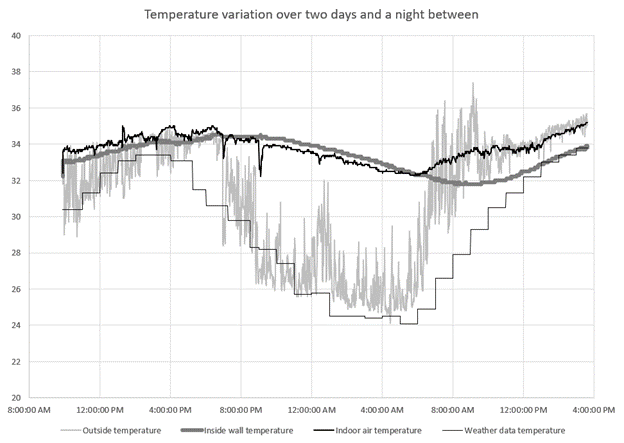
And here is the result over two days and a night.
The erratic grey trace is the air temperature outside the window. On the second morning, the sun heated the wall and our balcony, so the temperature rises quickly after daybreak, up to 10 °C above the weather data temperature for the immediate region close to Islamabad (thin black line with hourly steps). The first morning was partly cloudy so the temperature rise was less rapid. The temperature probe is only 20 cm from the insect screen on the window, so small air currents cause erratic temperature changes to be measured. (The thermocouple wire is only just long enough!).
The wall temperature rises from around 10 AM onwards, reaching a peak each day at about 8 pm.
The indoor air temperature reached a minimum of 32 °C around 6 AM, and varied by only two degrees through the day and night in a band around the maximum local weather data temperature.
When I presented data showing the temperatures at which people are sleeping in South Asian buildings in my recent post, I estimated the indoor temperature from the average of the weather data minimum and maximum for each location, and added three degrees for the urban heat island effect. The graph above shows the minimum overnight temperatue according to the local weather data was 24 °C and the maximum around 34 °C. I would have predicted that the room temperature for sleeping would have been 32 °C. In fact the room temperature was two degrees higher for most of the night.
The bedroom is on the top floor of a two storey house made from reinforced concrete slabs and solid 9 inch (23 cm) brick walls in the early 1960s with no insulation cavity. That’s standard building construction here, even today.
In other words, most people here in the South Asian summer are trying to sleep in temperatures even further above the human physiological limits that I estimated.
Remember this was not always the case.
Of course, the climate is warming gradually.
However, the high temperatures are mostly the result of urbanization and the lack of any insulation. That’s partly due to the lack of incentive. The World Bank and International Monetary Fund and other aid agencies helped Pakistan, India and many other countries construct electricity grids and hydropower dams on generous terms so electricity has been very cheap for a long time. Cheap electricity has promoted economic development and lifted billions out of poverty. But it cannot last, and has resulted in countries with little awareness of energy-efficiency measures.
Urbanization has eliminated shade and relocated people to apartments with nowhere cool to retreat to in the heat of summer. Air-conditioner run by wealthier residents, generators and vehicles belch out heat, adding to the urban heating as solar heat is absorbed by hard concrete surfaces. With 14 -15 hours of sunlight, it gets much hotter in city environments than the local weather data would indicate.
In earlier times, when today’s urban middle classes and poor lived in small buildings far from cities, often with thatched roofs and bamboo walls, they mostly slept at temperatures around 25 – 27 degrees, and moved into the open air at night when the temperature was higher. That’s the upper limit for human sleep, but still reasonably comfortable.
Today, hundreds of millions of people are literally cooking their minds and bodies, chasing the fabled wealth of cities.
Achieving the UN Sustainable Development Goals will require significant productivity improvements, and that’s only going to happen if urban masses can sleep properly at night. Coolzy can meet that need. It will take investment and time. At least it won’t cook the climate.
Let me know what you think about this issue. If you live without air-conditioning through the summer in South Asia, please tell me how you keep cool enough to sleep properly.
 THE MAKING OF AN EXPERT ENGINEER
Pingback: How do people survive months of intense heat?