Engineers Registration and Productivity in Australia 2025

This is an edited version of my original post on June 28. The final submission is now available from the links in this post. A big thank you to all the people who provided valuable feedback and suggestions for improvements.

This post releases my draft submission to the upcoming government productivity summit in Australia: it will be a written response to the call for public comment by the Productivity Commission.

In this submission I argue that the current system for registration of engineers in Australia is not fit for purpose. Instead of registering individual engineers we should register engineering firms instead because firms influence the performance of their engineers more that individual attributes like technical proficiency or competency.

I suspect this will be a novel idea for many and might be controversial. Any feedback will be welcome, especially counter-arguments.

Engineers are key actors influencing productivity in Australia. Engineers conceive, deliver, operate and sustain products, infrastructure and systems that enable ordinary Australians to be productive.

There are two significant engineering performance issues in Australia imposing significant avoidable costs on government, private firms and the community.

  1. Large and small engineering projects are failing to meet investor expectations, causing large losses for Australian companies and governments amounting to at least AUD 50 billion dollars annually. These failures arise partly because they remain hidden by their owners so engineers cannot learn from past mistakes, partly because of collaboration weaknesses, and partly because most engineers have only a weak understanding on how their work contributes economic and social value. Apart from the financial impacts, these failures are also delaying our energy transition from fossil fuels to renewables.
  2. Performances on routine engineering work such as maintenance show similarly large opportunities for improvement. UK and Scandinavian research has observed that even in large and well-organized companies, operating and maintenance mistakes contribute opportunity costs up to 50% of reported turnover. The core issues lie with the interactions between people, mediated by computer information systems.

Both issues have significant productivity impacts. The immense costs are potentially avoidable. Even a 10% reduction in losses would be a significant productivity boost.

Neither engineers nor engineering have been mentioned in Australian Productivity Commission reports since the mid-1990s. It seems that the significance of engineering as an influence on Australian productivity has been overlooked in the past few decades. Perhaps the magnitude of the issues I have raised will help to change that.

In the detailed submission, I explain why significantly improved workplace education would help engineers learn how to avoid these costs. Currently, there is no effective feedback of project and engineering practice failures and shortcomings, so it is not surprising that there is no performance improvement.

Policies that incentivise firms to invest more in workplace education for engineers could lift performance standards and might help avoid many of these costly failures.

In this submission, I argue that the most effective policy change would be to introduce a national engineering accreditation and registration agency (NEARA) for engineering firms. Firms would be reviewed and awarded ratings indicating their financial strength, discipline expertise, engineering capability development and training, strength of their systems, processes and procedures, and quality management. Initially it would likely be voluntary for all except firms involved in work posing large safety hazards such as apartment buildings over a certain height, major energy and chemical plants, nuclear installations, tunnelling, large underground or open cut mines, facilities with bio-hazards, etc. As the agency demonstrates its benefits, registration requirements might be widened. Alternatively, if the benefits are substantial, there might be no need to widen registration requirements because firms would seek accreditation as part of their business development.

Engineering professional societies would continue with certifications such as Chartered Engineer and EngExec because these qualifications would contribute towards accreditation ratings for engineering firms. However, the current state-based registration of individual engineers could be phased out over time.

A further policy suggestion is to require government agencies commissioning major engineering work costing more than $500 million to engage appropriately qualified consultants to review project plans before final investment decisions are authorised, and also to perform detailed evaluation studies on the projects and their outcomes 12 months or more after completion. The results of these evaluations should be made available to the federal agency responsible for registering and accrediting engineering firms so the knowledge gained can inform workplace education for engineers.

In this submission I explain why this national approach could be effective, and why the current state-based registration schemes are not fit for their intended purposes.

Illustration Credit: Adobe Photoshop generative AI produced this stereotypical image of engineers at work, supposedly in Art Deco 1930s style. Like all AI these days, AI propagates popular misconceptions about engineers. Engineers don’t wear hard hats in the office! And these safety helmets were not around in 1930! If it attracted you to read the post, then it did its job.

We Need Your Help to Preserve Engineering Heritage

Have you ever wondered why engineering achievements are often overlooked in history books?

Usually, the reason is that we engineers seldom provide information to help historians understand the significance of engineers’ contributions.

Across Australia, an energetic group of volunteers has been documenting Australia’s engineering heritage and explaining the significance of major engineering achievements. The lives and achievements of nearly 700 engineers have been documented, either as short biographies or as oral history recordings. 256 major engineering achievements have been awarded Engineering Heritage Markers since this group started in the 1980s.

The Australian Engineering Heritage website appears to be unique in the world: no other country seems to have accumulated its engineering heritage in an easily accessible form. For example, in the USA, the National Parks Service keeps a historical record but is it not easily accessible. Only a brief announcement reveals its existence.

I joined this group in 2022 and took on the role of secretary for the Western Australian committee. Since then, I have helped consolidate separate state websites into today’s single national site.

One of the challenges we face is that most people associate engineering history with prominent artefacts: bridges, highways, tall buildings, dams and railway engines. Yet these reveal little about the actual work of engineers. As I have explained in these pages, engineers often find it hard to explain what they do each day since much of it seems at first site to be a chaotic series of unplanned interruptions, phone calls, ad-hoc meetings and paperwork (although that’s mostly on computers these days). In my research interviews on engineering practice, the engineers would often ask “Why are you interviewing me? I hardly ever do any real engineering.”

Another challenge is a shortage of documentary evidence. Many of my retired former colleagues have destroyed all the records of their work. It was surprising that many of them hardly ever explained any of their work to their families. After their death, it’s often too late: lifetimes of engineering achievements have vanished with so many of them. In Western Australia, we are perversely fortunate that one of our most notable engineers committed suicide: Charles Yelverton O’Connor. If had died of natural causes, it is likely that we would know much less about his life and work.

We need your help now, before it is too late, before you retire.

Please send us your CV and papers describing significant achievements to heritage.engineersaustralia@gmail.com.

Mark papers confidential if necessary: those papers will be archived and indexed but the contents will remain private. Or, send an archive of documents to your state library. One day, we will find them and write about your achievements along with many others.

Please also send us the history of your firm or organisation, whatever form it is in. Don’t wait for the final perfect copy. You can always send an update later.

Come and join us as a volunteer. We have a few hundred volunteers around Australia in all the major cities. Most join for occasional company and the opportunity to retell stories, but about 20% actively research engineers and engineering projects, or help make the results accessible to the public on our website.

Within our community, there is also a growing cadre of Heritage Engineers who specialise in the preservation and restoration of historic buildings and other engineering artefacts. We run occasional courses to educate young professionals who are finding this to be an attractive professional specialisation.

Register for the 2024 Engineering Heritage Conference in Adelaide.

Learning Engineering Practice – Help Needed for the 2nd Edition

I was honoured to receive a message from Taylor & Francis, my publisher, telling me that the book has sold very well and they would like an updated edition.

On my list for improvements so far are:

  • How AI can help early career engineers and pitfalls to avoid (ie which types of AI can be trusted to be helpful);
  • More emphasis on LinkedIn for job seeking;
  • Distinguishing different kinds of engineering work in the introduction: professional engineering, engineering technologist and engineering technicians;
  • Ideas for early-career engineers on how to apply an understanding of social and economic value generation in engineering practice; and
  • Influence of climate in low-income countries.

I need your help, please.

Please re-familiarise yourself with the book, and send me suggestions for improvements, including any of your own experiences that could help with the topics above. Also, if you really think a chapter or part of a chapter is not needed, please let me know. I want to keep the book as short and easy to read as possible.

Send me an email or reply to this post and start a discussion.

Engineering Heritage – Construction of Narrows Bridges 1956 – 2006

As engineers, we often complain that the work of engineers is often overlooked in the history of human development.

Historians then point to the lack of source materials for them to work with. They are not really interested in the technical aspects of artefacts such as tools, bridges, machines, electrical supplies and so on. However, they are really interested in the people who created those artefacts, how they were used and how they influenced the behaviour of people at the time.

This is why recording and preserving our engineering heritage is so important. I started volunteering with the engineering heritage community of Western Australia last year, and the further I get into it, the more fascinating it is becoming.

Here is a recent achievement, even though it is work-in-progress: a detailed account of the construction of the Narrows Bridges in Perth.  

While any large bridge is an impressive artefact, it’s easy to lose sight of the personal stories behind it. Working on a large bridge, particularly one in a prominent location like these ones in front of the city, is an aspirational goal for any civil engineer. However, the high-pressure realities and psychological stresses involved in bridge design and construction can be a rude awakening. Some engineers walk away with psychological scars lasting decades.

Continue reading

Where’s the value in climate-smart engineering?

It was a privilege to be invited to lead a discussion on this at the recent Climate Smart Engineering conference by recorded video because I had to be in Pakistan for a family wedding at the same time.

Coolzy.com is my daily work: a portable refrigeration cooling machine running on just 300 Watts that provides the lowest cost personal cooling solution around, with minimal climate and environmental impact. That’s a nice illustration of climate-smart engineering. The need is critical right now! https://bit.ly/3uNY5H2

But it’s not so easy for many engineers to understand how their work creates economic, social or environmental value.

To help engineers better appreciate how their work creates value, Bill Williams and I have updated our Guide for Generating Value in an Engineering Enterprise, first released in 2017. It’s needed just as much today … Tell us what you think.

Continue reading

The Little AC that Can

I was brought up on the story of the little engine that could, taking on a seemingly impossible task with the mantra “I think I can… I think I can… I think I can… I think I can…”

We at Coolzy think we can help avoid many gigatonnes of CO2 emissions. Read and tell us if we’re wrong.

I have just returned from a month in Pakistan where the temperature in our bedroom never dropped below 30 °C, the upper physiological limit for sleeping with a powerful ceiling fan for cooling.

We slept comfortably with our Coolzy and an Igloo bed tent.

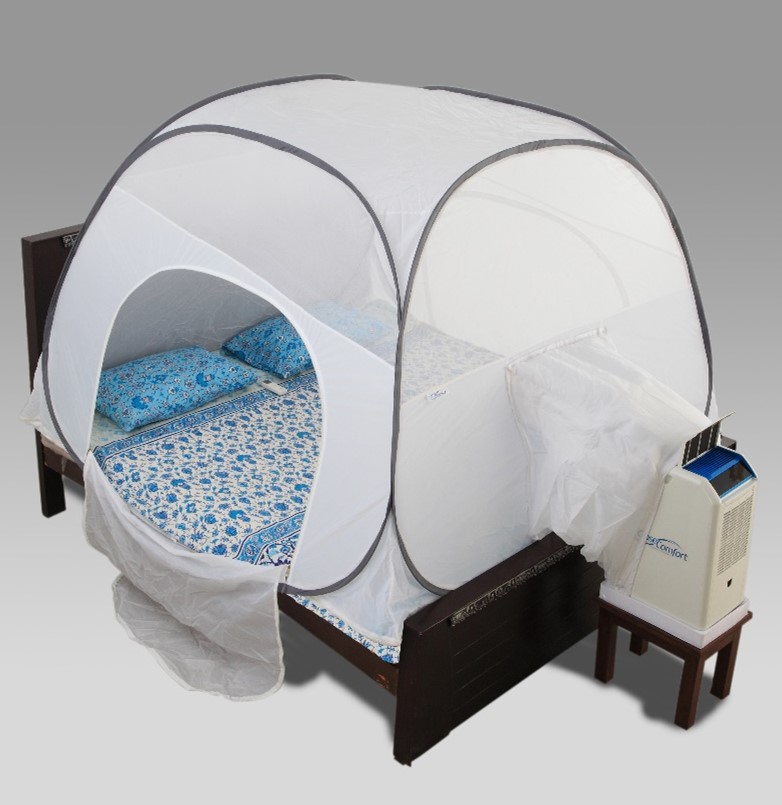
Coolzy and Igloo tent which my wife and I have used in Pakistan for 10 years now, sleeping in a first floor bedroom which reaches 40 °C. Like most houses in Pakistan it’s made from concrete with solid brick walls and no insulation at all, even on the roof.

Lives, health and prosperity across South Asia and many other countries will increasingly depend on artificial cooling. While only a tiny minority routinely enjoy air-conditioning today, perhaps 2%, a huge expansion lies ahead according to many predictions. However a large increase in greenhouse emissions will come with that expansion, adding as much as 13% of today’s global emissions when we need to get emissions to zero by 2050.

Can Coolzy help?  We think it can.

Thanks to the 2016 Kigali amendment to the 1972 Montreal protocol, the international community has agreed to phase out refrigerant gases that damage the ozone layer, and also gases that cause significant climate warming. Some of the latter gases cause thousands of times more warming than an equivalent amount of CO2 – the value for any particular gas is its “global warming potential” (GWP).

With the large-scale change from using fossil fuel to generate electricity to renewables such as solar, wind, geothermal, and hydro-electric power, also to nuclear power generation, the emissions of CO2 associated with electricity generation will fall significantly over time.

As a result, emissions from air-conditioners will fall from about 2035 onwards.

Broad global adoption of Coolzys can contribute an additional large reduction in emissions, but only when Coolzys have significantly eliminated the use of split air-conditioners, from about 2040 onwards.

We think Coolzys can reduce overall global emissions by 17 GtCO2, about half the current annual global emissions, about 35 times Australia’s current emissions. This document explains how in more detail .

Even if the use of conventional air-conditioners does not increase as many have predicted, Coolzys would increase human health, well-being and capacity for productive work, enabling faster progress towards achieving the Sustainable Development Goals (SDGs).

So how can Coolzys slash global emissions?

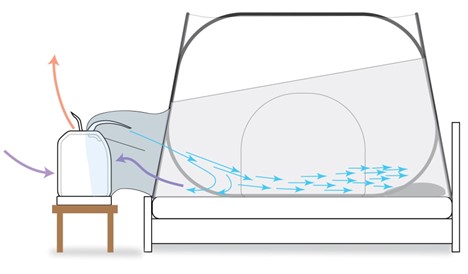
With the Igloo bed tent, a Coolzy delivers much the same comfort for sleeping as a split air-conditioner running on 5 or more times the amount of electricity. Darkness is significant – using solar electricity will rely on storage, significantly increasing the cost. That’s why many hot, low-income countries will continue to rely on fossil fuel electricity for decades to come: they need power at night for cooling.

The refrigerant gases in conventional air-conditioners will be around for decades too, with global warming potential a thousand or more times that of CO2. Coolzys use only 100 grams of propane inside permanently welded pipes. If it escapes, the climate impact is negligible in comparison, only 300 grams of CO2 compared with two or more tonnes of CO2 equivalent global warming from a conventional air-conditioner.

Using so little power, only 100 – 150 Watts per person, Coolzys cause far less emissions from burning fossil fuels, or far less investment in solar panels and batteries.

Anyone using a Coolzy instead of a conventional air-conditioner is saving around one tonne of CO2 emissions every year. A billion people doing that would save around a Gigatonne of CO2 emissions. Can we scale up to reach that level?

Coolzys are cheap to manufacture in bulk with between a third and half the materials needed for a conventional air-conditioner.

For people who cannot afford an energy-hungry conventional air-conditioner, people who today have to go without healthy sleep for months at a time with indoor temperatures in the high 30s up to 40 °C, Coolzy is transformative. With Coolzy, people regain their capacity for productive work, and babies no longer have their brains and bodies literally cooked in their first year of life. And yes, our experience shows that people with very low incomes by Western standards will buy them. It’s just a matter of time.

We are now selling Coolzys in more than 30 countries around the world, from Australia and Indonesia to Europe and the USA.

We will need massive investment, and we think that will come… soon. We think we can do it. What do you think?

If you’re sweltering in the European and USA heatwaves now, why not order one right now and try it for yourself?  (Please note that Igloo tents are still on their way to Europe and USA.)

Why do most hot countries remain poor?

In my first post in this thread, Pakistan is Never Boring, I introduced the key role that engineers have in economic development. In this series, I will explain how my research journey has led me to an understanding on what seems to be preventing economic and social development in countries like Pakistan and how engineers might remove most of the impediments. Pakistan is one of many countries experiencing an extremely hot climate, possibly the hottest on the planet, for several months every year. It also has cold winter months too.

Have you ever wondered why hot countries tend to be less prosperous, with some notable exceptions?  

Think of India, Bangladesh, Pakistan, Indonesia with more than a quarter of the world’s population. Then think of countries in Africa such as the Democratic Republic of Congo, Cameroon, Nigeria, Ghana, North and South Sudan, Kenya, Tanzania, Zimbabwe and many others.

There are also some cold countries that are poor too. Russia today is a relatively poor country.

Of course, measurable economic wealth is not necessarily related to happiness, but it certainly helps with health and education.

READ MORE, ABOUT 10 MINUTES – BUT IT WILL OPEN YOUR EYES TO SOMETHING NEW

Beyond Competencies

Is it possible that much of the engineering education research community, myself included, has misunderstood the notion of competency? With many others, I think, I was unaware of literature drawing attention to some of the mistakes that can easily be made when talking about competency. I conclude by suggesting a way forward, beyond ‘competencies’.

How did I reach this position?

Continue reading (15 mins)

What we know, and mostly don’t know about engineering practices

This is the script for my REES-AAEE-2021 Keynote. The video is here, and the powerpoint slides are available on request if you would like to use them for education purposes.

For a sustainable future, we need large productivity improvements. Engineers are critical contributors, but we need deeper understandings of engineering practices and how education influences them to make the necessary improvements. Without this, education reform arguments are fragile at best.

Read the Script of the presentation (30 mins)

Winners of the Global Cooling Prize announced

I rarely stay up late to watch serious TV. However, this announcement, three years in the making, was something that I just couldn’t miss.

At Close Comfort, we sincerely congratulate the Global Cooling Prize 2021 winners along with all the judges and participating teams! Everyone involved in the Prize helped develop new green technologies that can cool people around the world without warming or harming our planet.

Continue reading