Engineers Registration and Productivity in Australia 2025

This is an edited version of my original post on June 28. The final submission is now available from the links in this post. A big thank you to all the people who provided valuable feedback and suggestions for improvements.

This post releases my draft submission to the upcoming government productivity summit in Australia: it will be a written response to the call for public comment by the Productivity Commission.

In this submission I argue that the current system for registration of engineers in Australia is not fit for purpose. Instead of registering individual engineers we should register engineering firms instead because firms influence the performance of their engineers more that individual attributes like technical proficiency or competency.

I suspect this will be a novel idea for many and might be controversial. Any feedback will be welcome, especially counter-arguments.

Engineers are key actors influencing productivity in Australia. Engineers conceive, deliver, operate and sustain products, infrastructure and systems that enable ordinary Australians to be productive.

There are two significant engineering performance issues in Australia imposing significant avoidable costs on government, private firms and the community.

  1. Large and small engineering projects are failing to meet investor expectations, causing large losses for Australian companies and governments amounting to at least AUD 50 billion dollars annually. These failures arise partly because they remain hidden by their owners so engineers cannot learn from past mistakes, partly because of collaboration weaknesses, and partly because most engineers have only a weak understanding on how their work contributes economic and social value. Apart from the financial impacts, these failures are also delaying our energy transition from fossil fuels to renewables.
  2. Performances on routine engineering work such as maintenance show similarly large opportunities for improvement. UK and Scandinavian research has observed that even in large and well-organized companies, operating and maintenance mistakes contribute opportunity costs up to 50% of reported turnover. The core issues lie with the interactions between people, mediated by computer information systems.

Both issues have significant productivity impacts. The immense costs are potentially avoidable. Even a 10% reduction in losses would be a significant productivity boost.

Neither engineers nor engineering have been mentioned in Australian Productivity Commission reports since the mid-1990s. It seems that the significance of engineering as an influence on Australian productivity has been overlooked in the past few decades. Perhaps the magnitude of the issues I have raised will help to change that.

In the detailed submission, I explain why significantly improved workplace education would help engineers learn how to avoid these costs. Currently, there is no effective feedback of project and engineering practice failures and shortcomings, so it is not surprising that there is no performance improvement.

Policies that incentivise firms to invest more in workplace education for engineers could lift performance standards and might help avoid many of these costly failures.

In this submission, I argue that the most effective policy change would be to introduce a national engineering accreditation and registration agency (NEARA) for engineering firms. Firms would be reviewed and awarded ratings indicating their financial strength, discipline expertise, engineering capability development and training, strength of their systems, processes and procedures, and quality management. Initially it would likely be voluntary for all except firms involved in work posing large safety hazards such as apartment buildings over a certain height, major energy and chemical plants, nuclear installations, tunnelling, large underground or open cut mines, facilities with bio-hazards, etc. As the agency demonstrates its benefits, registration requirements might be widened. Alternatively, if the benefits are substantial, there might be no need to widen registration requirements because firms would seek accreditation as part of their business development.

Engineering professional societies would continue with certifications such as Chartered Engineer and EngExec because these qualifications would contribute towards accreditation ratings for engineering firms. However, the current state-based registration of individual engineers could be phased out over time.

A further policy suggestion is to require government agencies commissioning major engineering work costing more than $500 million to engage appropriately qualified consultants to review project plans before final investment decisions are authorised, and also to perform detailed evaluation studies on the projects and their outcomes 12 months or more after completion. The results of these evaluations should be made available to the federal agency responsible for registering and accrediting engineering firms so the knowledge gained can inform workplace education for engineers.

In this submission I explain why this national approach could be effective, and why the current state-based registration schemes are not fit for their intended purposes.

Illustration Credit: Adobe Photoshop generative AI produced this stereotypical image of engineers at work, supposedly in Art Deco 1930s style. Like all AI these days, AI propagates popular misconceptions about engineers. Engineers don’t wear hard hats in the office! And these safety helmets were not around in 1930! If it attracted you to read the post, then it did its job.

STORM at Stanford – An AI Breakthrough?

I have been finalizing the chapter drafts of the new edition of my book Learning Engineering Practice. The publishers were keen for me to address AI, artificial intelligence (or actual incompetence?). In the first chapter I addressed this topic, arguing that AI tools really just average all the hearsay and misplaced notions one can pick up on the internet. Even the best (Perplexity) could not pick up systematic research on engineering practice that shows engineers are not doing what they’re taught in school. Any engineer can tell you that, of course. But could STORM, a new AI tool configured for real researchers, really figure that out? I actually hoped that it would, and I would therefore have to modify my final first chapter draft.

I heard a glowing account of STORM on Youtube from Danny Lui at Sydney University in a TEQSA video: you don’t get a much more authoritative source on higher education than that in Australia. So I decided to give it a trial run. My research focus is engineering practice, systematic ethnographic research studies on what engineers really do, which is not what we teach in universities.

STORM was touted as a big advance on ChatGPT because, for one, the references it gives you are actual sources, not invented ones.

I first asked for a review of research studies on what engineers actually do in their work. The response was a rather boring “average” of widespread popular notions on what engineers do, framed in terms of design, problem-solving and communication skills. Collaboration was acknowledged as a critical element (10/10), mentioning that engineers frequently attend meetings with colleagues, clients and project managers. Effective communication, it said, is essential for bridging the gap between technical and non-technical team members. And then gave me a reference to a site advertising a recruitment agency, not a peer reviewed source.

Unfortunately, STORM was unable to distinguish systematically researched studies on engineers at work from hearsay and gossip sources. It’s analysis of engineering work reflects widely held but woefully inaccurate ideas that circulate in engineering faculties, where the faculty teach but reluctantly admit that they know nothing about practicing as an engineer.

So, I decided to give STORM another chance. I gave it a more precise prompt: “Engineering practice, the nature of engineering work”. Unfortunately, the results were broadly similar, almost word for word in some sections.

So, as a last chance, I gave an even more precise prompt: ethnographic studies of engineers at work. Again the results were disappointing and again STORM could not differentiate between systematic peer-reviewed research studies in books and journals on the one hand, and social media gossip on the other. The single study it managed to find was inaccessible because the URL was incorrect. However, I did locate the 25 year old article and found it was very superficial in its findings and coverage.

Would this be useful for an entry-level researcher? Absolutely no. The results are misleading, dated, based on commercial hearsay and gossip. Any student using this tool will get is a lot of trouble with a research supervisor who knows the topic. This has done little to move my current assessment of AI as artificial incompetence. And, I have argued that the AI business case does not stack up, given my knowledge from being in robotics and artificial intelligence since the early 1970s and my current knowledge of the digital advertising industry.

Sometime, soon perhaps, but maybe still in a few years, I foresee a horrible financial crash when investors finally work out they have been sold just hype. But don’t bank on it.

Picture Credit: Photoshop generative image production. I acknowledge all the artists whose work was scraped off the internet, probably without their knowledge, and certainly without any financial compensation, to enable software like Photoshop to generate images like this.

Added

After testing STORM, a friend suggested I try Claude. Claude provided similar responses to Perplexity and ChatGPT. I directly asked Claude for a literature review of ethnographic research on engineering practice and how it reveals what engineers actually do, and what we don’t know about engineering practice, the result was 7/10 for a student literature review. It was still easy to identify it as AI-generated.

The point here is that it was only because I knew that the research existed, and the keywords to find it, that Claude was able to generate a satisfactory result. A Google Scholar search yielded far more and more up-to-date references. Claude (and Perplexity) were able to identify relevant issues.

Only Claude was able to write a reasonable literature review document. So, yes, nice tools which would definitely help get a young researcher started, but no substitute for actually reading the literature and allowing time to understand what it tells us.

All of the Chatbots responded to the initial question “What do engineers do” with popular misconceptions, and none could point out that researchers have shown these to be misconceptions without being specifically directed to that research.

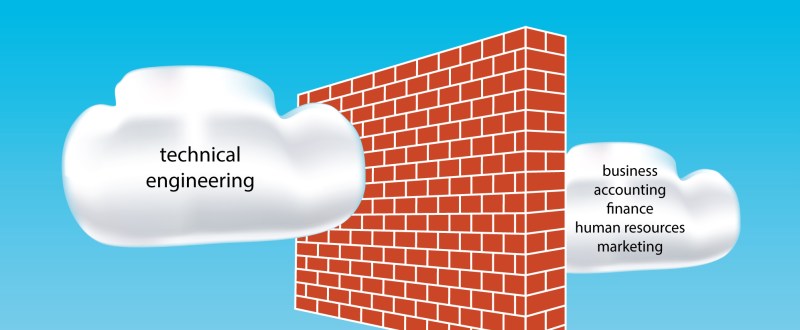
When I asked Claude what it takes to transform an engineer’s concept for a solution into practical reality, again the response provided an outline of the technical steps, missing a lot of what has to happen. Crucially, it missed the essential requirement for finance! This reflects the widespread intellectual separation between engineering writing and business.

So AI chatbots, predictably, are a good way to assess popular misconceptions on a topic. A knowledgeable human researcher is needed to help them get closer to the best known truth of the matter. And Google Scholar (and other specialized search tools) are essential for getting to the contemporary literature.

An unclear nuclear debate

We are entering yet another nuclear debate in Australia because opposition leader Peter Dutton raised the prospect of nuclear electricity generation as an election strategy. The choice of a nuclear-powered submarine fleet opened Pandora’s box just enough for the emerging scent to reawaken faded memories of nuclear dreams … and nightmares.

Unfortunately there are many misconceptions circulating in our community. In this short article I will mention some of the more misleading ones. If you hear of other misconceptions not included below, please write and I will add them.

It’s a courageous election strategy by the opposition. Another Fukushima, Three Mile Island or Chernobyl would dampen if not extinguish their election hopes instantly. Zaporizhzhia’s nuclear plant, the largest in Europe, sits precariously in shutdown mode on the front line of the Ukraine war, the same state that the Fukushima power plant was in when a tsunami disabled its cooling systems. A major nuclear accident cannot be ruled out before the election.

Many people outside the political opposition are now advocating nuclear electricity as a cheap way to get Australia’s electricity emissions to zero. For example, Robert Parker (video, website) argued the “yes” case strongly, though his report could do with more detailed references to help readers understand where he found his data.

In Engineers Australia we could do better in the public sphere. We kicked an own goal when we cancelled his presentation citing an imaginary illness, thereby promoting his views more effectively that he could have done on his own. There’s a brief policy document dated 2020 on the web site and another contradictory document dated 2015.

The acting chief engineer, Bernie Foley and Prof. Lachlan Blackall presented to the Australian parliamentary enquiry in December 2024. Their submission emphasized the critical role of engineers in navigating the energy transition to eliminate emissions and the need to build a capable workforce to achieve that. When asked whether the 2030 target was achievable, Lachlan said we are behind schedule to achieve the 2030 targets, and we need many more engineering graduates from universities. We also need to get many more of our migrant engineers into engineering work than we do today.

I hope Engineers Australia or someone else can create a compelling video that would help educate our community. In the meantime, this is a small contribution based on extensive engineering knowledge and first-hand experience working in and researching the Australian nuclear industry.

Let’s examine some common arguments used by nuclear advocates that build on public misconceptions.

1. Other countries like France and the USA are pursuing nuclear, so we should too.

Australia is different. We have the almost unique combination of high solar radiation, strong winds, and lots of land. That is a natural endowment, like our minerals, that potentially makes us a renewable energy super-power. Other countries have much less land, less sunshine, and less wind which means that they need to seriously embrace nuclear energy, with all its long-term disadvantages. Since the 1960s, the hope has been that nuclear fusion power would provide hundreds of times more energy. However, those hopes have not been realised so the older and less energy-productive fission technology is now their main alternative.

2. Cheaper electricity prices in places like Canada and USA demonstrate that nuclear reduces the cost of electricity.

Domestic electricity consumption, even much of the commercial consumption in Australia is dominated by the need for summer cooling. We therefore have a large seasonal and daily fluctuation in energy demand which means we need more generation capacity and electricity distribution infrastructure for the same average energy consumption per household or business. That has a much larger impact on energy prices than the methods used to generate electricity. Another factor is the rapid adoption of rooftop solar generation in Australia: we lead the world in this aspect of solar power generation. However, this has forced our energy utilities to install additional protection equipment since power now flows in two directions whereas our systems were designed for one-directional power flow, long before solar became significant. Also, our main electricity generators are now required to run at widely varying capacity, from full power to idle, and sometimes that changes in minutes rather than hours. Our generators, most dating from the 1960s and 1970s, were never designed for that way of using them. Finally, our smaller population is spread over much larger areas than in other countries: that also makes electricity distribution more expensive.

3. Renewable electricity generation needs more materials and transmission lines than nuclear generators, and recycling these materials is costly and difficult.

It’s partly true. As yet, we don’t have cost-effective recycling systems for solar panels and wind turbines. However, once we have millions of tons of the waste material, our mining expertise will come into play. In Australia, we have the world’s best experts when it comes to extracting traces of minerals in millions of tons of sand and rock.

Unfortunately, nuclear advocates side-step the recycling problem for nuclear generating plants (known as decommissioning). This is an immensely costly future problem for countries like France, Russia, USA and UK that have invested heavily in nuclear energy. The decommissioning cost for nuclear plants is still unquantifiable which is why it is quietly overlooked in the cost estimates.

4. Excess solar power on sunny days is wasted.

Again, true enough to get away with it. However, nuclear advocates miss the power of electricity markets. Varying electricity prices encourage companies, even households, to invest in clever ways to make use of almost free excess renewable energy. Incentives created by variable electricity pricing enable engineers to devise smart ways to store energy and use it faster when it’s cheap, and rely more on stored energy and slowing industrial processes at night and in cloudy weather with less wind electricity. Fixed electricity prices are now engineering heritage, along with steam engines. Smart batteries and electric cars are starting to provide immense possibilities for effectively using what nuclear advocates call “spilled” energy. However, it takes time for energy utilities, companies and even households to respond. In a few years, we will waste much less solar energy than we do today.

5. Storing energy is expensive

Battery costs alone are falling faster than ever, thanks largely (but not alone) to Chinese investment. Intense competition between firms, even countries, is bringing a variety of cheap energy storage solutions to commercial reality. And it’s not just batteries.

In my home, we use a 250 Watt electric fan to draw cool night air through the building in summer so we don’t need to use energy-intensive room air-conditioners during the day. Our bricks store the daytime heat until our fan removes it the next evening.

Our neighbours use a five-star efficiency rated 15,000 Watt ducted air-conditioning system.

 Our fan technology dates back to the 1950s. Their air-conditioning system uses “21st century smart home artificial intelligence”.

Which do you think is smarter?

Ingenuity provides cheap and simple energy storage solutions when we need them, and often the solutions were invented decades or centuries earlier.

6. Base load demand has to be met with a stable and reliable power supply

We need to think about energy demand as well as supply. Take heating and cooling for comfort, just as an example, and again I will cite the case of our neighbour. Their 15,000 Watt ducted air-conditioning system heats their entire home during our short Perth winter. We use 50 Watt electric throw rugs when we need warmth and we wear winter clothes.

Our neighbour now regrets being taken in by advertising slogans like “21st century smart home artificial intelligence”.

In less benign climates, the energy demand is harder to reduce.

My passion is developing tiny energy-efficient air-conditioners to enable people to sleep comfortably with indoor building temperatures exceeding 40 degrees. (See Coolzy.com, also this recent article, a newspaper op-ed in Pakistan, and an even more recent technical paper.)

Those temperatures are today’s reality for two billion people in South Asia from April to October. With climate warming, another billion people will experience this in the near future.

Conventional thinking has led to predictions that India’s electricity demand will multiply 10 to 20 times in the coming decades because people will buy hundreds of millions of air-conditioners to combat the heat.

In the extreme heat of South Asia, people need 12- 15 degrees of apparent cooling to be able to sleep, even more than conventional air conditioners can provide.  Our machines can provide that, but with only 10% – 20% of the energy, while protecting them from mosquitos at the same time. Air-conditioning with these machines would be affordable and sustainable for the entire population who need them.

There is no guarantee that electricity demand has to increase without limits.

7. Large projects usually fail to meet investors’ expectations

Private sector data on tens of thousands of projects reveal that two thirds of large engineeringl projects costing more than one billion dollars provided investors with half or less the promised economic benefits. One project in six was a total loss and performances are declining, year by year. Governments usually decline to invite external assessors so we have to rely on public domain data as Bent Flyvbjerg collected, revealing that government projects perform worse because politicians change the requirements.

These risks can be reduced. Hire the best project team, prepare detailed plans well in advance to identify all the difficulties and solutions, and execute lots of similar projects on a smaller scale rather than a few big ones. Unfortunately, that advice conflicts with the the nuclear ambitions proposed by the opposition, especially as Australian resources industries tend to monopolize the best project teams.

8. It’s an election!

There are some positives emerging from this debate. Most Australians on all sides of politics now accept that getting greenhouse emissions to zero is essential. That’s a big advance from where we were just 5 years ago. As a small nation, we can change quickly when we need to. Let’s hope we don’t need more catastrophic bushfires to shift our thinking again.

At first, I thought this debate would be a catastrophe. About the worst way to choose your long-term options for energy supply is to ask voters to choose. As Ross Garnault and others have pointed out, government committees are not a smart way to make these choices either. It is much better to provide incentives and education to enable thousands or millions of smart Australians to find effective solutions that work for them. Our failure to put an effective price on greenhouse emissions has already cost us many cheap emission reduction opportunities.

Then, I remembered that an election promise today is tomorrow’s cyber junk. A single election will not have that much long term influence, fortunately.

On my own, I can’t do much to change market incentives. But, as an engineer I can help educate people and offer smarter solutions that others can adopt if they want to.

I read reports from different agencies in Australia and contribute where I can to a robust public discussion that should help us reach a future energy supply system in Australia that will serve us well.

As an engineering community, we need to be humble and help our community understand that they need to let engineers get on with this critical change in our energy systems with the least possible political interference.

We should be cautious in supporting proposals that require large public investments because these proposals inevitably give politicians a platform to draw attention to their particular views. The history of the Sydney Harbour Bridge is instructive on this issue, and there is a wonderful engineering heritage repository of information here on that topic. I feel confident that we can rely on private investments for most of the new energy infrastructure we need.

As engineers, we need to work with a better understanding on how to create value for investors and communities to ease the flow of investment into new power generation capacity. We will need that if we are to achieve the ambitious timescale for the changes we have to make.

Dalle accessed through ChatGPT generated the title image with the prompt “Create a photographic image of a nuclear power station near an Australian beach.” I am not sure it really reaches the mark, but as think of AI as Artificial Incompetence until proved otherwise!


We Need Your Help to Preserve Engineering Heritage

Have you ever wondered why engineering achievements are often overlooked in history books?

Usually, the reason is that we engineers seldom provide information to help historians understand the significance of engineers’ contributions.

Across Australia, an energetic group of volunteers has been documenting Australia’s engineering heritage and explaining the significance of major engineering achievements. The lives and achievements of nearly 700 engineers have been documented, either as short biographies or as oral history recordings. 256 major engineering achievements have been awarded Engineering Heritage Markers since this group started in the 1980s.

The Australian Engineering Heritage website appears to be unique in the world: no other country seems to have accumulated its engineering heritage in an easily accessible form. For example, in the USA, the National Parks Service keeps a historical record but is it not easily accessible. Only a brief announcement reveals its existence.

I joined this group in 2022 and took on the role of secretary for the Western Australian committee. Since then, I have helped consolidate separate state websites into today’s single national site.

One of the challenges we face is that most people associate engineering history with prominent artefacts: bridges, highways, tall buildings, dams and railway engines. Yet these reveal little about the actual work of engineers. As I have explained in these pages, engineers often find it hard to explain what they do each day since much of it seems at first site to be a chaotic series of unplanned interruptions, phone calls, ad-hoc meetings and paperwork (although that’s mostly on computers these days). In my research interviews on engineering practice, the engineers would often ask “Why are you interviewing me? I hardly ever do any real engineering.”

Another challenge is a shortage of documentary evidence. Many of my retired former colleagues have destroyed all the records of their work. It was surprising that many of them hardly ever explained any of their work to their families. After their death, it’s often too late: lifetimes of engineering achievements have vanished with so many of them. In Western Australia, we are perversely fortunate that one of our most notable engineers committed suicide: Charles Yelverton O’Connor. If had died of natural causes, it is likely that we would know much less about his life and work.

We need your help now, before it is too late, before you retire.

Please send us your CV and papers describing significant achievements to heritage.engineersaustralia@gmail.com.

Mark papers confidential if necessary: those papers will be archived and indexed but the contents will remain private. Or, send an archive of documents to your state library. One day, we will find them and write about your achievements along with many others.

Please also send us the history of your firm or organisation, whatever form it is in. Don’t wait for the final perfect copy. You can always send an update later.

Come and join us as a volunteer. We have a few hundred volunteers around Australia in all the major cities. Most join for occasional company and the opportunity to retell stories, but about 20% actively research engineers and engineering projects, or help make the results accessible to the public on our website.

Within our community, there is also a growing cadre of Heritage Engineers who specialise in the preservation and restoration of historic buildings and other engineering artefacts. We run occasional courses to educate young professionals who are finding this to be an attractive professional specialisation.

Register for the 2024 Engineering Heritage Conference in Adelaide.

Learning Engineering Practice – Help Needed for the 2nd Edition

I was honoured to receive a message from Taylor & Francis, my publisher, telling me that the book has sold very well and they would like an updated edition.

On my list for improvements so far are:

  • How AI can help early career engineers and pitfalls to avoid (ie which types of AI can be trusted to be helpful);
  • More emphasis on LinkedIn for job seeking;
  • Distinguishing different kinds of engineering work in the introduction: professional engineering, engineering technologist and engineering technicians;
  • Ideas for early-career engineers on how to apply an understanding of social and economic value generation in engineering practice; and
  • Influence of climate in low-income countries.

I need your help, please.

Please re-familiarise yourself with the book, and send me suggestions for improvements, including any of your own experiences that could help with the topics above. Also, if you really think a chapter or part of a chapter is not needed, please let me know. I want to keep the book as short and easy to read as possible.

Send me an email or reply to this post and start a discussion.

AI: Artificial Incompetence or Actual Idiocy?

I have watched AI pronouncements over the last year or so with great interest, like so many others.

It is 30 years since I argued at a robotics and AI conference, much to the horror and anguish of many computer science colleagues, that AI was better interpreted as artificial incompetence than intelligence.

Has anything really changed in that time?

In my 1992 book, Shear Magic, Robots for Shearing Sheep, I argued that so-called intelligent computers were illusions and that the greatest irony of artificial intelligence research is that it demonstrates how shallow our concepts of mind and intelligence really are. “All we have learned is that the thinking we associate with intelligence is the easiest part to replicate with computers.” Yet, every human shares perception and thinking abilities that, even now, we have not even begun to understand. If you think ChatGPT is intelligent, just ask it to drive your car to the office.

I must acknowledge that the ability of our machines to translate text into other useful languages has advanced. If you are very careful with the original text to avoid ambiguities and colloquial expressions, writing text that is as boring to read as possible, then translation into many languages is near faultless. Instruction manuals and legal documents translate easily, even with Google translate. I use DeepL considered to be better than Google, though with fewer languages.

In this post, I want to explain why I think that we are not going to see many of the great AI advances so many people have confidently predicted in the last year or two. Not for a while at least. I have fallen into the same trap myself: I confidently predicted that self-driving cars would be an every-day reality by 2017!

My argument is based on simple economics that I have learned by stumbling into marketing to help the world embrace Coolzy.

Every summer day, my team members scan digital dashboards to assess ROAS, our return on advertising spend. These days we place most of our advertising with Google through search ads, YouTube, and the shopping strip at the top of your search page, also display ads that appear on so many websites.

In Australia, for example, we aim for a ROAS of about five, meaning that we have to spend $100 on digital advertising to generate $500 of sales revenue. In Pakistan and Indonesia where Coolzy is so much more attractive, we can confidently aim for ROAS of 20 or more, sometimes more than 50. The reason why Google, Meta and the other vast digital platforms are so profitable is that advertising with them really works.

Let’s explore this a little deeper.

Typically, we pay Google or Meta around one dollar every time someone clicks on one of our ads and lands at our website. We pay a tiny fraction of that every time one of our ads is displayed on a screen, somewhere in the world.

Yet only one in a hundred website visitors buys a Coolzy, perhaps two on a good day with a threatening heatwave announced. That’s why we have to pay for those other hundred or so ad clicks.

If, like me, you enjoy tossing provocative questions at ChatGPT and Gemini, you are benefiting from the money we pay to Google for our ads. It is millions of companies like us, large and small, paying for digital advertising, that have made Google what it is today. Google and Meta live on advertising revenue. And the world only has so much money to spend on advertising.

A few days ago, Google announced their next big step in AI… Gemini. I asked it my usual questions like “tell me about Pakistani members of the Australian cricket team”. Gemini matched ChatGPT’s response last year, naming Usman Khawaja and Fawad Ahmed, an improvement on Bard that completely flunked the answer. In contrast, Bing’s new ChatGPT copilot only listed members of the Pakistan cricket team in its response this morning, a big backward step from ChatGPT last year. Many others have made similar comments.

Google, Meta, OpenAi and so many others are chewing through vast amounts of electricity and investors’ cash, running hundreds of thousands of nVidia gaming chips to build what are now known as large language models (LLMs), essentially vast networks of mathematical statistics that predict the next few words you are looking for without any understanding of what the words mean. The models emerge as they scoop up and process trillions of words from websites across the internet. Machine translation abilities rely on huge collections of documents appearing simultaneously in two or more languages. The UN and EU websites are goldmines for translation engines, reflecting the efforts of countless human translators over the last few decades.

Like many others now, I suspect that this huge expenditure of treasure and energy will disappoint in the end. Vast investments are vanishing like water into sand in the hope that some huge advance in advertising effectiveness will emerge, because it is only advertising that will sustain the successful winner in this race. And, something drastic has to change to make the economics add up because these LLMs are enormously more costly to run than traditional search engines.

So, back to Coolzy.

What would persuade me to pay $10 or even $50 to Google, Microsoft or even Amazon, for someone to tap on a Coolzy ad on their smart phone?

I would do that if, and only if the person that taps the ad is really going to buy a Coolzy. That means that Google, Microsoft and Amazon have to predict human behaviour ten times, or fifity times better than they can now. And I can’t see any sign of that kind of improvement, yet.

Recently I came across perplexity.ai, initially impressing me. I asked questions about Coolzy and its responses were so good that I am tempted to recommend it to our website visitors if our primitive chatbot can’t answer their questions. Perplexity have announced a copilot that engages a user in a conversation to help narrow down the focus of their ‘knowledge’ search. I thought to myself, Ah ha, this might lead be a search engine that really can find someone ready to buy a Coolzy. If it works for us by finding people ready to buy a Coolzy, I would pay far more than Google for their website visitors. The perplexity business model just might eclipse Google, or so I thought.

I put perplexity’s copilot through an extended test. I pretended to be someone looking for a low-power aircon that works in tropical humid heat, but with no knowledge of Coolzy. Sadly, perplexity’s copilot failed. I was more confused and frustrated by the experience than helped. Despite telling me that evaporative aircons don’t work in high humidity, it kept recommending the tiny USB-powered so-called air conditioners like evapolar that use water evaporation, and are little more than toys. They only work in low humidity and even then, only produce a tiny cooling effect.

Thinking about this, I realized that perplexity has perplexed itself because it cannot distinguish truth from faction, the vast quantity of facile text created by marketers to drive search engines to misleading websites, building upon confusing ideas that even engineers cling to about air conditioning. Hence artificial incompetence.

For a decade or more, commercial and respectable website builders alike have been seeking Google search rankings that depend on vast amounts of text that mention something that might be relevant for a potential visitor, but the text does not need to be either factual or logical. Now, one of the main applications being touted for ChatGPT and Gemini is producing faction even faster to attract search engines, increasing the pile of meaningless internet content exponentially.

I am helping to build a website about the history of engineering in Western Australia. Despite the large quantity of carefully researched text there, Google ignores it because it thinks the site is unlikely to attract a paying customer. Perplexity knows about it, but not Google.

LLMs, therefore, seem to have become imprisoned by the marketing industry that has created vast quantities of meaningless text to promote website Google search rankings. LLMs are not much good at generating anything logical anyway. They regurgitate a digested form of the garbage that represents so much of the internet today. In universities, we struggle to help our students distinguish the small quantities of reliable information out there.

Even academic publishing has become an ever-growing archive of papers, most of vanishing significance, that few people ever read apart from the authors. Academics are rewarded for publishing papers, not reading them.

LLMs will need to be able to distinguish truth and logic from faction if they are to provide anything reliably helpful. And that will take a long time, I suspect.

I often wonder whether the AI hype all been a ploy by the IT industry to seduce investors once more. The industry has monopolized the venture capital supply for two decades without creating appreciable productivity gains. The transition to renewables and electric vehicles is taking an ever-increasing share of investment capital, casting shade over silicon valley’s cathedrals.

Roger Penrose argued that biological intelligence relies on quantum effects (see his book, The Emperor’s New Mind). He inspired physicists to work on quantum computing, until recently flagged as the next great step in AI. However, I suspect that practical applications are still decades away.

Is AI really taking human civilization to the next inflection point?

Yawn.

It’s time to talk about Coolzy. No LLM will keep billions of people cool in the coming century.

Image by Anca Gabriela at umsplash.com

PS: WordPress now offers to generate a summary of my post (presumably using AI). I tried it an immediately discarded the result which was so mind-numbingly more boring than my own writing. If that’s the future of writing, the internet will become humanity’s greatest garbage dump even faster! Bring back books, please.

Engineering Heritage – Construction of Narrows Bridges 1956 – 2006

As engineers, we often complain that the work of engineers is often overlooked in the history of human development.

Historians then point to the lack of source materials for them to work with. They are not really interested in the technical aspects of artefacts such as tools, bridges, machines, electrical supplies and so on. However, they are really interested in the people who created those artefacts, how they were used and how they influenced the behaviour of people at the time.

This is why recording and preserving our engineering heritage is so important. I started volunteering with the engineering heritage community of Western Australia last year, and the further I get into it, the more fascinating it is becoming.

Here is a recent achievement, even though it is work-in-progress: a detailed account of the construction of the Narrows Bridges in Perth.  

While any large bridge is an impressive artefact, it’s easy to lose sight of the personal stories behind it. Working on a large bridge, particularly one in a prominent location like these ones in front of the city, is an aspirational goal for any civil engineer. However, the high-pressure realities and psychological stresses involved in bridge design and construction can be a rude awakening. Some engineers walk away with psychological scars lasting decades.

Continue reading

Where’s the value in climate-smart engineering?

It was a privilege to be invited to lead a discussion on this at the recent Climate Smart Engineering conference by recorded video because I had to be in Pakistan for a family wedding at the same time.

Coolzy.com is my daily work: a portable refrigeration cooling machine running on just 300 Watts that provides the lowest cost personal cooling solution around, with minimal climate and environmental impact. That’s a nice illustration of climate-smart engineering. The need is critical right now! https://bit.ly/3uNY5H2

But it’s not so easy for many engineers to understand how their work creates economic, social or environmental value.

To help engineers better appreciate how their work creates value, Bill Williams and I have updated our Guide for Generating Value in an Engineering Enterprise, first released in 2017. It’s needed just as much today … Tell us what you think.

Continue reading

The Little AC that Can

I was brought up on the story of the little engine that could, taking on a seemingly impossible task with the mantra “I think I can… I think I can… I think I can… I think I can…”

We at Coolzy think we can help avoid many gigatonnes of CO2 emissions. Read and tell us if we’re wrong.

I have just returned from a month in Pakistan where the temperature in our bedroom never dropped below 30 °C, the upper physiological limit for sleeping with a powerful ceiling fan for cooling.

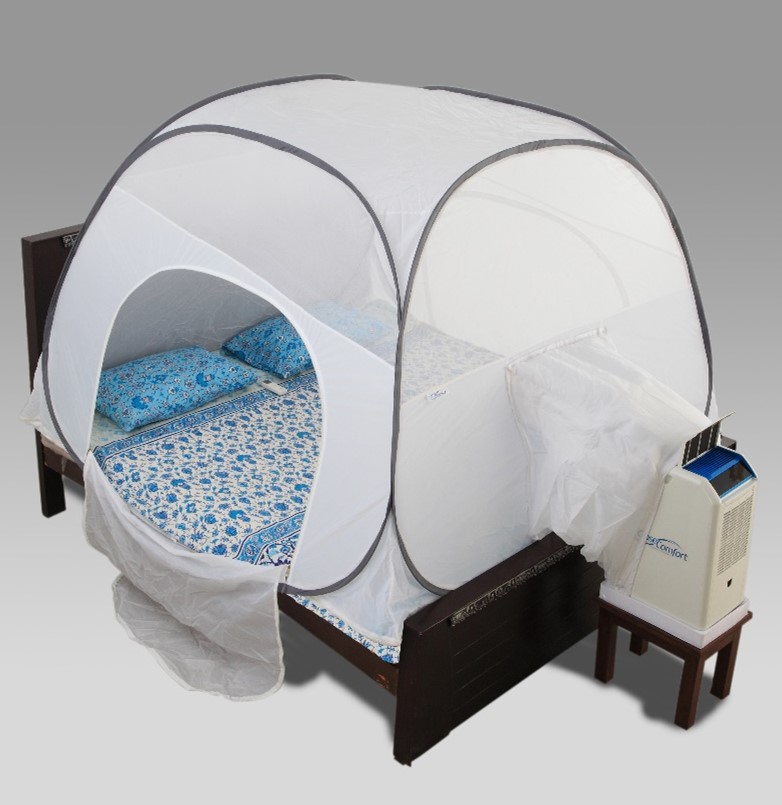
We slept comfortably with our Coolzy and an Igloo bed tent.

Coolzy and Igloo tent which my wife and I have used in Pakistan for 10 years now, sleeping in a first floor bedroom which reaches 40 °C. Like most houses in Pakistan it’s made from concrete with solid brick walls and no insulation at all, even on the roof.

Lives, health and prosperity across South Asia and many other countries will increasingly depend on artificial cooling. While only a tiny minority routinely enjoy air-conditioning today, perhaps 2%, a huge expansion lies ahead according to many predictions. However a large increase in greenhouse emissions will come with that expansion, adding as much as 13% of today’s global emissions when we need to get emissions to zero by 2050.

Can Coolzy help?  We think it can.

Thanks to the 2016 Kigali amendment to the 1972 Montreal protocol, the international community has agreed to phase out refrigerant gases that damage the ozone layer, and also gases that cause significant climate warming. Some of the latter gases cause thousands of times more warming than an equivalent amount of CO2 – the value for any particular gas is its “global warming potential” (GWP).

With the large-scale change from using fossil fuel to generate electricity to renewables such as solar, wind, geothermal, and hydro-electric power, also to nuclear power generation, the emissions of CO2 associated with electricity generation will fall significantly over time.

As a result, emissions from air-conditioners will fall from about 2035 onwards.

Broad global adoption of Coolzys can contribute an additional large reduction in emissions, but only when Coolzys have significantly eliminated the use of split air-conditioners, from about 2040 onwards.

We think Coolzys can reduce overall global emissions by 17 GtCO2, about half the current annual global emissions, about 35 times Australia’s current emissions. This document explains how in more detail .

Even if the use of conventional air-conditioners does not increase as many have predicted, Coolzys would increase human health, well-being and capacity for productive work, enabling faster progress towards achieving the Sustainable Development Goals (SDGs).

So how can Coolzys slash global emissions?

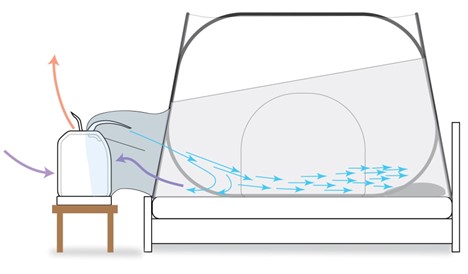
With the Igloo bed tent, a Coolzy delivers much the same comfort for sleeping as a split air-conditioner running on 5 or more times the amount of electricity. Darkness is significant – using solar electricity will rely on storage, significantly increasing the cost. That’s why many hot, low-income countries will continue to rely on fossil fuel electricity for decades to come: they need power at night for cooling.

The refrigerant gases in conventional air-conditioners will be around for decades too, with global warming potential a thousand or more times that of CO2. Coolzys use only 100 grams of propane inside permanently welded pipes. If it escapes, the climate impact is negligible in comparison, only 300 grams of CO2 compared with two or more tonnes of CO2 equivalent global warming from a conventional air-conditioner.

Using so little power, only 100 – 150 Watts per person, Coolzys cause far less emissions from burning fossil fuels, or far less investment in solar panels and batteries.

Anyone using a Coolzy instead of a conventional air-conditioner is saving around one tonne of CO2 emissions every year. A billion people doing that would save around a Gigatonne of CO2 emissions. Can we scale up to reach that level?

Coolzys are cheap to manufacture in bulk with between a third and half the materials needed for a conventional air-conditioner.

For people who cannot afford an energy-hungry conventional air-conditioner, people who today have to go without healthy sleep for months at a time with indoor temperatures in the high 30s up to 40 °C, Coolzy is transformative. With Coolzy, people regain their capacity for productive work, and babies no longer have their brains and bodies literally cooked in their first year of life. And yes, our experience shows that people with very low incomes by Western standards will buy them. It’s just a matter of time.

We are now selling Coolzys in more than 30 countries around the world, from Australia and Indonesia to Europe and the USA.

We will need massive investment, and we think that will come… soon. We think we can do it. What do you think?

If you’re sweltering in the European and USA heatwaves now, why not order one right now and try it for yourself?  (Please note that Igloo tents are still on their way to Europe and USA.)

It’s Hotter than I Expected

Visiting Islamabad at the height of summer is not everyone’s idea of fun. With Coolzy to keep me comfortable, I can enjoy the superb mangos in season at the moment. For a week, the temperature in our bedroom hovered around 38 – 40 °C, but with the Igloo tent, we slept through the nights, not noticing the load shedding.

However, I was surprised.

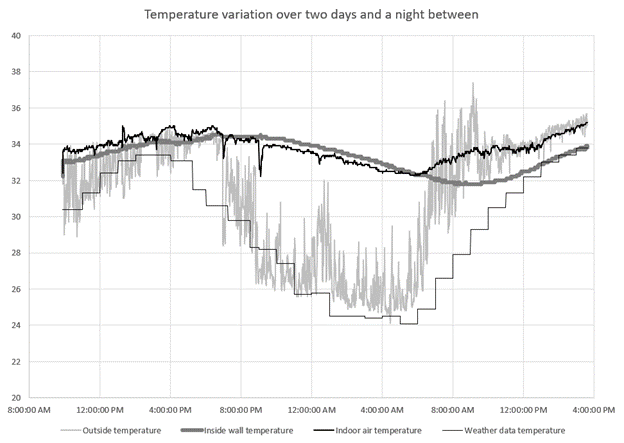
On one of the cooler days I used a simple thermocouple data logger to record the temperature just outside our open window, on the inside of the wall, and also the air temperature at 40 cm above floor level, around the height of our mattress.

And here is the result over two days and a night.

Read More (5 mins)