

I was brought up on the story of the little engine that could, taking on a seemingly impossible task with the mantra “I think I can… I think I can… I think I can… I think I can…”
We at Coolzy think we can help avoid many gigatonnes of CO2 emissions. Read and tell us if we’re wrong.
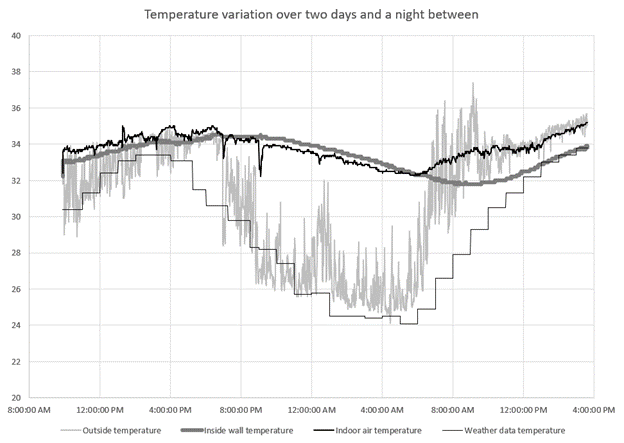
I have just returned from a month in Pakistan where the temperature in our bedroom never dropped below 30 °C, the upper physiological limit for sleeping with a powerful ceiling fan for cooling.
We slept comfortably with our Coolzy and an Igloo bed tent.
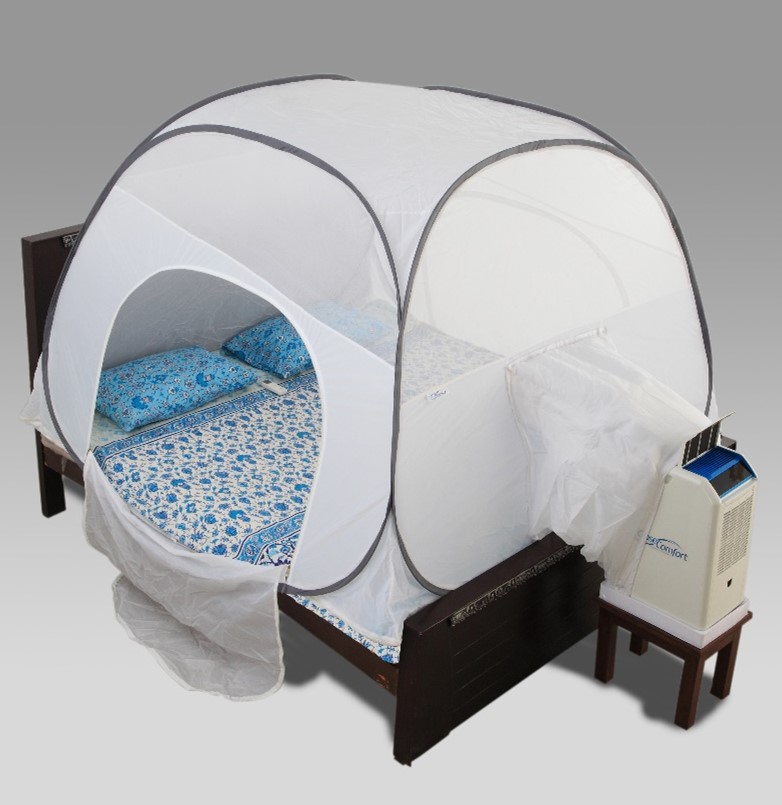
Coolzy and Igloo tent which my wife and I have used in Pakistan for 10 years now, sleeping in a first floor bedroom which reaches 40 °C. Like most houses in Pakistan it’s made from concrete with solid brick walls and no insulation at all, even on the roof.
Lives, health and prosperity across South Asia and many other countries will increasingly depend on artificial cooling. While only a tiny minority routinely enjoy air-conditioning today, perhaps 2%, a huge expansion lies ahead according to many predictions. However a large increase in greenhouse emissions will come with that expansion, adding as much as 13% of today’s global emissions when we need to get emissions to zero by 2050.
Can Coolzy help? We think it can.
Thanks to the 2016 Kigali amendment to the 1972 Montreal protocol, the international community has agreed to phase out refrigerant gases that damage the ozone layer, and also gases that cause significant climate warming. Some of the latter gases cause thousands of times more warming than an equivalent amount of CO2 – the value for any particular gas is its “global warming potential” (GWP).
With the large-scale change from using fossil fuel to generate electricity to renewables such as solar, wind, geothermal, and hydro-electric power, also to nuclear power generation, the emissions of CO2 associated with electricity generation will fall significantly over time.
As a result, emissions from air-conditioners will fall from about 2035 onwards.
Broad global adoption of Coolzys can contribute an additional large reduction in emissions, but only when Coolzys have significantly eliminated the use of split air-conditioners, from about 2040 onwards.
We think Coolzys can reduce overall global emissions by 17 GtCO2, about half the current annual global emissions, about 35 times Australia’s current emissions. This document explains how in more detail .
Even if the use of conventional air-conditioners does not increase as many have predicted, Coolzys would increase human health, well-being and capacity for productive work, enabling faster progress towards achieving the Sustainable Development Goals (SDGs).
So how can Coolzys slash global emissions?
With the Igloo bed tent, a Coolzy delivers much the same comfort for sleeping as a split air-conditioner running on 5 or more times the amount of electricity. Darkness is significant – using solar electricity will rely on storage, significantly increasing the cost. That’s why many hot, low-income countries will continue to rely on fossil fuel electricity for decades to come: they need power at night for cooling.
The refrigerant gases in conventional air-conditioners will be around for decades too, with global warming potential a thousand or more times that of CO2. Coolzys use only 100 grams of propane inside permanently welded pipes. If it escapes, the climate impact is negligible in comparison, only 300 grams of CO2 compared with two or more tonnes of CO2 equivalent global warming from a conventional air-conditioner.
Using so little power, only 100 – 150 Watts per person, Coolzys cause far less emissions from burning fossil fuels, or far less investment in solar panels and batteries.
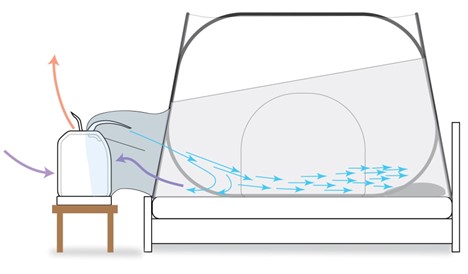
Anyone using a Coolzy instead of a conventional air-conditioner is saving around one tonne of CO2 emissions every year. A billion people doing that would save around a Gigatonne of CO2 emissions. Can we scale up to reach that level?
Coolzys are cheap to manufacture in bulk with between a third and half the materials needed for a conventional air-conditioner.
For people who cannot afford an energy-hungry conventional air-conditioner, people who today have to go without healthy sleep for months at a time with indoor temperatures in the high 30s up to 40 °C, Coolzy is transformative. With Coolzy, people regain their capacity for productive work, and babies no longer have their brains and bodies literally cooked in their first year of life. And yes, our experience shows that people with very low incomes by Western standards will buy them. It’s just a matter of time.
We are now selling Coolzys in more than 30 countries around the world, from Australia and Indonesia to Europe and the USA.
We will need massive investment, and we think that will come… soon. We think we can do it. What do you think?
If you’re sweltering in the European and USA heatwaves now, why not order one right now and try it for yourself? (Please note that Igloo tents are still on their way to Europe and USA.)


 THE MAKING OF AN EXPERT ENGINEER