

We are entering yet another nuclear debate in Australia because opposition leader Peter Dutton raised the prospect of nuclear electricity generation as an election strategy. The choice of a nuclear-powered submarine fleet opened Pandora’s box just enough for the emerging scent to reawaken faded memories of nuclear dreams … and nightmares.
Unfortunately there are many misconceptions circulating in our community. In this short article I will mention some of the more misleading ones. If you hear of other misconceptions not included below, please write and I will add them.
It’s a courageous election strategy by the opposition. Another Fukushima, Three Mile Island or Chernobyl would dampen if not extinguish their election hopes instantly. Zaporizhzhia’s nuclear plant, the largest in Europe, sits precariously in shutdown mode on the front line of the Ukraine war, the same state that the Fukushima power plant was in when a tsunami disabled its cooling systems. A major nuclear accident cannot be ruled out before the election.
Many people outside the political opposition are now advocating nuclear electricity as a cheap way to get Australia’s electricity emissions to zero. For example, Robert Parker (video, website) argued the “yes” case strongly, though his report could do with more detailed references to help readers understand where he found his data.
In Engineers Australia we could do better in the public sphere. We kicked an own goal when we cancelled his presentation citing an imaginary illness, thereby promoting his views more effectively that he could have done on his own. There’s a brief policy document dated 2020 on the web site and another contradictory document dated 2015.
The acting chief engineer, Bernie Foley and Prof. Lachlan Blackall presented to the Australian parliamentary enquiry in December 2024. Their submission emphasized the critical role of engineers in navigating the energy transition to eliminate emissions and the need to build a capable workforce to achieve that. When asked whether the 2030 target was achievable, Lachlan said we are behind schedule to achieve the 2030 targets, and we need many more engineering graduates from universities. We also need to get many more of our migrant engineers into engineering work than we do today.
I hope Engineers Australia or someone else can create a compelling video that would help educate our community. In the meantime, this is a small contribution based on extensive engineering knowledge and first-hand experience working in and researching the Australian nuclear industry.
Let’s examine some common arguments used by nuclear advocates that build on public misconceptions.
1. Other countries like France and the USA are pursuing nuclear, so we should too.
Australia is different. We have the almost unique combination of high solar radiation, strong winds, and lots of land. That is a natural endowment, like our minerals, that potentially makes us a renewable energy super-power. Other countries have much less land, less sunshine, and less wind which means that they need to seriously embrace nuclear energy, with all its long-term disadvantages. Since the 1960s, the hope has been that nuclear fusion power would provide hundreds of times more energy. However, those hopes have not been realised so the older and less energy-productive fission technology is now their main alternative.
2. Cheaper electricity prices in places like Canada and USA demonstrate that nuclear reduces the cost of electricity.
Domestic electricity consumption, even much of the commercial consumption in Australia is dominated by the need for summer cooling. We therefore have a large seasonal and daily fluctuation in energy demand which means we need more generation capacity and electricity distribution infrastructure for the same average energy consumption per household or business. That has a much larger impact on energy prices than the methods used to generate electricity. Another factor is the rapid adoption of rooftop solar generation in Australia: we lead the world in this aspect of solar power generation. However, this has forced our energy utilities to install additional protection equipment since power now flows in two directions whereas our systems were designed for one-directional power flow, long before solar became significant. Also, our main electricity generators are now required to run at widely varying capacity, from full power to idle, and sometimes that changes in minutes rather than hours. Our generators, most dating from the 1960s and 1970s, were never designed for that way of using them. Finally, our smaller population is spread over much larger areas than in other countries: that also makes electricity distribution more expensive.
3. Renewable electricity generation needs more materials and transmission lines than nuclear generators, and recycling these materials is costly and difficult.
It’s partly true. As yet, we don’t have cost-effective recycling systems for solar panels and wind turbines. However, once we have millions of tons of the waste material, our mining expertise will come into play. In Australia, we have the world’s best experts when it comes to extracting traces of minerals in millions of tons of sand and rock.
Unfortunately, nuclear advocates side-step the recycling problem for nuclear generating plants (known as decommissioning). This is an immensely costly future problem for countries like France, Russia, USA and UK that have invested heavily in nuclear energy. The decommissioning cost for nuclear plants is still unquantifiable which is why it is quietly overlooked in the cost estimates.
4. Excess solar power on sunny days is wasted.
Again, true enough to get away with it. However, nuclear advocates miss the power of electricity markets. Varying electricity prices encourage companies, even households, to invest in clever ways to make use of almost free excess renewable energy. Incentives created by variable electricity pricing enable engineers to devise smart ways to store energy and use it faster when it’s cheap, and rely more on stored energy and slowing industrial processes at night and in cloudy weather with less wind electricity. Fixed electricity prices are now engineering heritage, along with steam engines. Smart batteries and electric cars are starting to provide immense possibilities for effectively using what nuclear advocates call “spilled” energy. However, it takes time for energy utilities, companies and even households to respond. In a few years, we will waste much less solar energy than we do today.
5. Storing energy is expensive
Battery costs alone are falling faster than ever, thanks largely (but not alone) to Chinese investment. Intense competition between firms, even countries, is bringing a variety of cheap energy storage solutions to commercial reality. And it’s not just batteries.
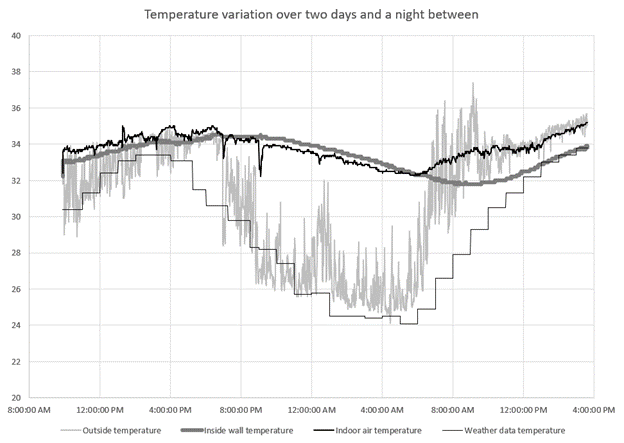
In my home, we use a 250 Watt electric fan to draw cool night air through the building in summer so we don’t need to use energy-intensive room air-conditioners during the day. Our bricks store the daytime heat until our fan removes it the next evening.
Our neighbours use a five-star efficiency rated 15,000 Watt ducted air-conditioning system.
Our fan technology dates back to the 1950s. Their air-conditioning system uses “21st century smart home artificial intelligence”.
Which do you think is smarter?
Ingenuity provides cheap and simple energy storage solutions when we need them, and often the solutions were invented decades or centuries earlier.
6. Base load demand has to be met with a stable and reliable power supply
We need to think about energy demand as well as supply. Take heating and cooling for comfort, just as an example, and again I will cite the case of our neighbour. Their 15,000 Watt ducted air-conditioning system heats their entire home during our short Perth winter. We use 50 Watt electric throw rugs when we need warmth and we wear winter clothes.
Our neighbour now regrets being taken in by advertising slogans like “21st century smart home artificial intelligence”.
In less benign climates, the energy demand is harder to reduce.
My passion is developing tiny energy-efficient air-conditioners to enable people to sleep comfortably with indoor building temperatures exceeding 40 degrees. (See Coolzy.com, also this recent article, a newspaper op-ed in Pakistan, and an even more recent technical paper.)
Those temperatures are today’s reality for two billion people in South Asia from April to October. With climate warming, another billion people will experience this in the near future.
Conventional thinking has led to predictions that India’s electricity demand will multiply 10 to 20 times in the coming decades because people will buy hundreds of millions of air-conditioners to combat the heat.
In the extreme heat of South Asia, people need 12- 15 degrees of apparent cooling to be able to sleep, even more than conventional air conditioners can provide. Our machines can provide that, but with only 10% – 20% of the energy, while protecting them from mosquitos at the same time. Air-conditioning with these machines would be affordable and sustainable for the entire population who need them.
There is no guarantee that electricity demand has to increase without limits.
7. Large projects usually fail to meet investors’ expectations
Private sector data on tens of thousands of projects reveal that two thirds of large engineeringl projects costing more than one billion dollars provided investors with half or less the promised economic benefits. One project in six was a total loss and performances are declining, year by year. Governments usually decline to invite external assessors so we have to rely on public domain data as Bent Flyvbjerg collected, revealing that government projects perform worse because politicians change the requirements.
These risks can be reduced. Hire the best project team, prepare detailed plans well in advance to identify all the difficulties and solutions, and execute lots of similar projects on a smaller scale rather than a few big ones. Unfortunately, that advice conflicts with the the nuclear ambitions proposed by the opposition, especially as Australian resources industries tend to monopolize the best project teams.
8. It’s an election!
There are some positives emerging from this debate. Most Australians on all sides of politics now accept that getting greenhouse emissions to zero is essential. That’s a big advance from where we were just 5 years ago. As a small nation, we can change quickly when we need to. Let’s hope we don’t need more catastrophic bushfires to shift our thinking again.
At first, I thought this debate would be a catastrophe. About the worst way to choose your long-term options for energy supply is to ask voters to choose. As Ross Garnault and others have pointed out, government committees are not a smart way to make these choices either. It is much better to provide incentives and education to enable thousands or millions of smart Australians to find effective solutions that work for them. Our failure to put an effective price on greenhouse emissions has already cost us many cheap emission reduction opportunities.
Then, I remembered that an election promise today is tomorrow’s cyber junk. A single election will not have that much long term influence, fortunately.
On my own, I can’t do much to change market incentives. But, as an engineer I can help educate people and offer smarter solutions that others can adopt if they want to.
I read reports from different agencies in Australia and contribute where I can to a robust public discussion that should help us reach a future energy supply system in Australia that will serve us well.
As an engineering community, we need to be humble and help our community understand that they need to let engineers get on with this critical change in our energy systems with the least possible political interference.
We should be cautious in supporting proposals that require large public investments because these proposals inevitably give politicians a platform to draw attention to their particular views. The history of the Sydney Harbour Bridge is instructive on this issue, and there is a wonderful engineering heritage repository of information here on that topic. I feel confident that we can rely on private investments for most of the new energy infrastructure we need.
As engineers, we need to work with a better understanding on how to create value for investors and communities to ease the flow of investment into new power generation capacity. We will need that if we are to achieve the ambitious timescale for the changes we have to make.
Dalle accessed through ChatGPT generated the title image with the prompt “Create a photographic image of a nuclear power station near an Australian beach.” I am not sure it really reaches the mark, but as think of AI as Artificial Incompetence until proved otherwise!

 THE MAKING OF AN EXPERT ENGINEER