News from America – Retail Armageddon

News from Mid-West America – Retail Armageddon

I have just returned from a few weeks in America. Even having witnessed genuine fear of what might happen and a near 20% fall in savings investments, I was still shocked at developments reported to us last night.

We discussed Coolzy, our personal air-conditioners, with a buyer representing a major American retail chain serving rural communities with over 2,000 stores nationwide. The buyer is a staunch republican in a typical “red” mid-west state.

The discussion opened with a remark that our meeting was planned before the President announced the extra tariffs on Chinese imports. The buyer apologised and said that there would be no possibility of them stocking Coolzy, even though we already have stock in the USA.

He told us that the company had ships full of thousands of containers turning around and heading back to China. The company has extended terms with many factories, but has paid out advance deposits on products that now will not even reach America.

However, significant stock orders were in containers on ships that could not be turned around.

He described the situation as ‘Armageddon’ for his company and the industry. The company does not even have finance to pay the import tariffs due on the stock orders due to arrive in the next 2 -3 weeks. He was unsure what would happen, but seizure of their goods was a distinct possibility, he thought. Paying for containers to be returned to China might have been an option, but finding shipping capacity for that is proving to be difficult.

He said that he has been advised that their retail turnover could fall by more than 90% as they cannot replenish most of their retail product lines. But that’s not the only factor.

Critically for farmers, one of the companies in their group supplies a wide range of spare parts for harvesting equipment and tractors. The company has minimal stock because most parts are ordered from China as they are needed and flown in by air freight. Five to ten is a typical stock level. Already, they are running out of spare parts and the main harvesting season has not even started.

Many of their farmer customers are telling him that they may not be able sell the produce they harvest for Chinese customers. So, they are cancelling all non-essential orders and deferring paying outstanding bills.

The company president has reached out to Republican senators, but they have told him that the White House is not listening.

He closed the meeting by commenting “I have always voted Republican, but as far as I’m concerned, that ….. in the White House needs to get out now. It’s Armageddon for our business. That’s the only way I can describe it. I’m sorry, we shouldn’t be taking your time to talk politics, but you need to know what’s happening over here. I’m not even sure I will have a job in a month or two.”

Image credit: Haotian Zheng at Unsplash.com

The Little AC that Can

I was brought up on the story of the little engine that could, taking on a seemingly impossible task with the mantra “I think I can… I think I can… I think I can… I think I can…”

We at Coolzy think we can help avoid many gigatonnes of CO2 emissions. Read and tell us if we’re wrong.

I have just returned from a month in Pakistan where the temperature in our bedroom never dropped below 30 °C, the upper physiological limit for sleeping with a powerful ceiling fan for cooling.

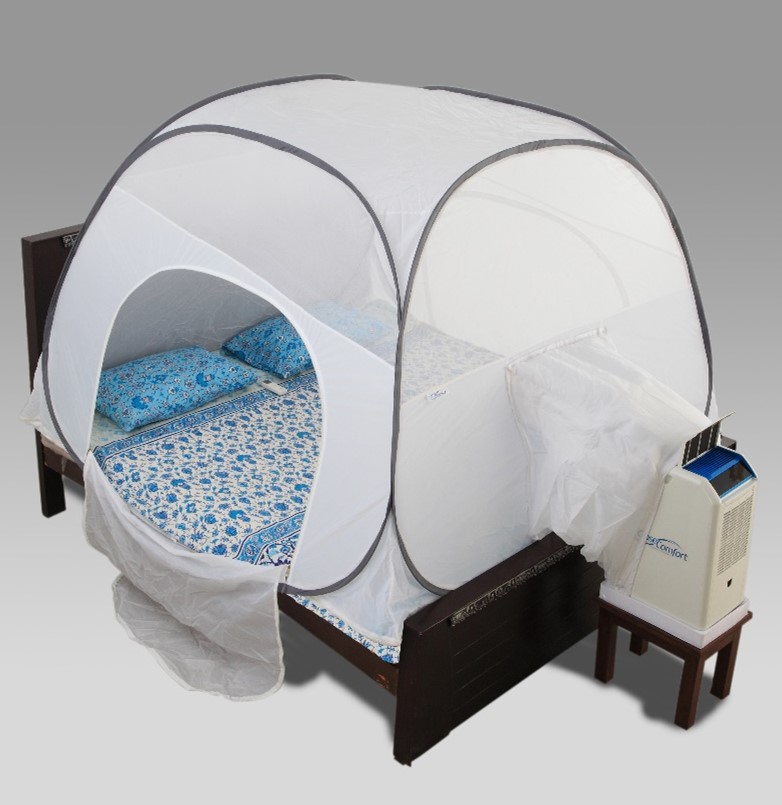
We slept comfortably with our Coolzy and an Igloo bed tent.

Coolzy and Igloo tent which my wife and I have used in Pakistan for 10 years now, sleeping in a first floor bedroom which reaches 40 °C. Like most houses in Pakistan it’s made from concrete with solid brick walls and no insulation at all, even on the roof.

Lives, health and prosperity across South Asia and many other countries will increasingly depend on artificial cooling. While only a tiny minority routinely enjoy air-conditioning today, perhaps 2%, a huge expansion lies ahead according to many predictions. However a large increase in greenhouse emissions will come with that expansion, adding as much as 13% of today’s global emissions when we need to get emissions to zero by 2050.

Can Coolzy help?  We think it can.

Thanks to the 2016 Kigali amendment to the 1972 Montreal protocol, the international community has agreed to phase out refrigerant gases that damage the ozone layer, and also gases that cause significant climate warming. Some of the latter gases cause thousands of times more warming than an equivalent amount of CO2 – the value for any particular gas is its “global warming potential” (GWP).

With the large-scale change from using fossil fuel to generate electricity to renewables such as solar, wind, geothermal, and hydro-electric power, also to nuclear power generation, the emissions of CO2 associated with electricity generation will fall significantly over time.

As a result, emissions from air-conditioners will fall from about 2035 onwards.

Broad global adoption of Coolzys can contribute an additional large reduction in emissions, but only when Coolzys have significantly eliminated the use of split air-conditioners, from about 2040 onwards.

We think Coolzys can reduce overall global emissions by 17 GtCO2, about half the current annual global emissions, about 35 times Australia’s current emissions. This document explains how in more detail .

Even if the use of conventional air-conditioners does not increase as many have predicted, Coolzys would increase human health, well-being and capacity for productive work, enabling faster progress towards achieving the Sustainable Development Goals (SDGs).

So how can Coolzys slash global emissions?

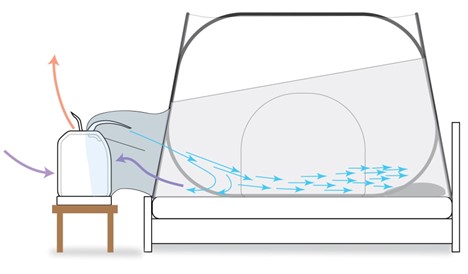
With the Igloo bed tent, a Coolzy delivers much the same comfort for sleeping as a split air-conditioner running on 5 or more times the amount of electricity. Darkness is significant – using solar electricity will rely on storage, significantly increasing the cost. That’s why many hot, low-income countries will continue to rely on fossil fuel electricity for decades to come: they need power at night for cooling.

The refrigerant gases in conventional air-conditioners will be around for decades too, with global warming potential a thousand or more times that of CO2. Coolzys use only 100 grams of propane inside permanently welded pipes. If it escapes, the climate impact is negligible in comparison, only 300 grams of CO2 compared with two or more tonnes of CO2 equivalent global warming from a conventional air-conditioner.

Using so little power, only 100 – 150 Watts per person, Coolzys cause far less emissions from burning fossil fuels, or far less investment in solar panels and batteries.

Anyone using a Coolzy instead of a conventional air-conditioner is saving around one tonne of CO2 emissions every year. A billion people doing that would save around a Gigatonne of CO2 emissions. Can we scale up to reach that level?

Coolzys are cheap to manufacture in bulk with between a third and half the materials needed for a conventional air-conditioner.

For people who cannot afford an energy-hungry conventional air-conditioner, people who today have to go without healthy sleep for months at a time with indoor temperatures in the high 30s up to 40 °C, Coolzy is transformative. With Coolzy, people regain their capacity for productive work, and babies no longer have their brains and bodies literally cooked in their first year of life. And yes, our experience shows that people with very low incomes by Western standards will buy them. It’s just a matter of time.

We are now selling Coolzys in more than 30 countries around the world, from Australia and Indonesia to Europe and the USA.

We will need massive investment, and we think that will come… soon. We think we can do it. What do you think?

If you’re sweltering in the European and USA heatwaves now, why not order one right now and try it for yourself?  (Please note that Igloo tents are still on their way to Europe and USA.)

Physiological Effects of Hot Climates

(Updated June 20, 2023)

Temperatures in Delhi reached 46 °C this week. How does this kind of heat affect people?

In my last post “Why do most hot countries remain poor?” I summarised explanations by influential economists and geographers. I reviewed the quantitative evidence that demonstrates the strong inverse link between climate temperature and economic productivity.

Of course, a correlation does not necessarily imply a cause.

23 years on, we now have research on physiology that has helped us understand a little more on how people are affected by hot climates. While there are still large gaps in our understanding, there is now little doubt that cooling is essential for economic and social development, even more so as climate warming raises temperatures everywhere.

READ MORE – ABOUT 20 MINUTES, BUT WORTH THE EFFORT

Summer Again

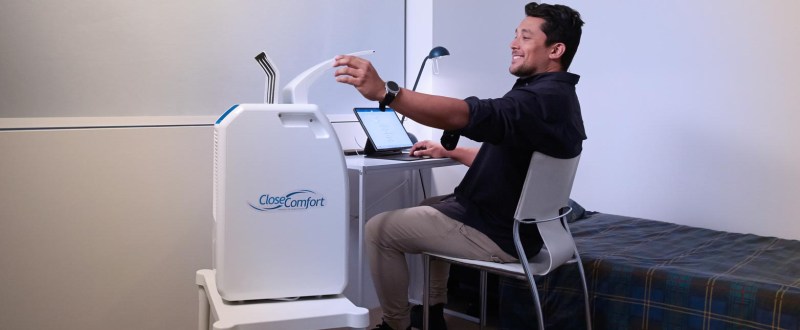
It’s summer (but it’s not me in the photo): the magnetic needle inside my old-fashioned max-min mercury thermometer shows the temperature on my veranda reached 47°C recently. Close Comfort, an old PC8 model made in 2015 improved with the latest compact focus enhancer. It sits at the end of my bed each night and my Igloo tent is in the wardrobe should I need it. I move it to my study if I’m working from home.

As the inventor, it’s nice to be able to tell you that I use it practically all the time I need cooling.

It’s not just that I invented it.  Or the knowledge that even one small tree absorbs more CO2 than is created at the power station by the electricity that it uses. Even less CO2 with solar electricity.

I have even noticed that I adapt to the heat more easily when using Close Comfort, so I don’t have use it all the time. There is evidence emerging from physiological studies that might support this perception. It’s good because my wife uses it too in her study: the kitchen where she just has to reach across to make herself cups of tea.

Continue reading

Corona virus will be more lethal for startups than bushfires

Update May 1st 2020: A modest success. With the help of friends and politicians, I and others managed to persuade the Australian Treasury to modify the JobKeeper scheme to include startups like Close Comfort and many others. A lifesaver for us. Thank you to all those who listened and acted!

The Australian government’s business rescue packages, while welcome, have overlooked the future: thousands of small and successful startups. Startups in many other less fortunate countries may struggle to survive.

Our company, Close Comfort (www.closecomfort.com), a small family-owned business, cannot demonstrate a 30% year on year loss of business to be eligible for assistance because we have invested to grow our sales. Now we face a similar financial catastrophe like tourism and hospitality businesses as our sales and sources of investment capital dry up simultaneously.

Continue reading

Lost in Urdu translation?

Today with the internet and web sites like Freelancer.com, you would think it is possible to find native speakers of any language who can readily do translation for you and prepare documents like instruction manuals.  And with computer packages like InDesign, you would think that the job of setting up a professionally printed instruction booklet again would be trivially easy.  Well, maybe in some languages, but not in Urdu.  This has been a fascinating learning experience, and frustrating too at times.

I never imagined that translating our air conditioner user manual and getting it designed ready for printing would have been so difficult.  This manual is critical for us: few people will read it, but the few who do will pass on that knowhow to lots of other people.  It’s really important that they get it right.

Continue reading