
Listening is critical
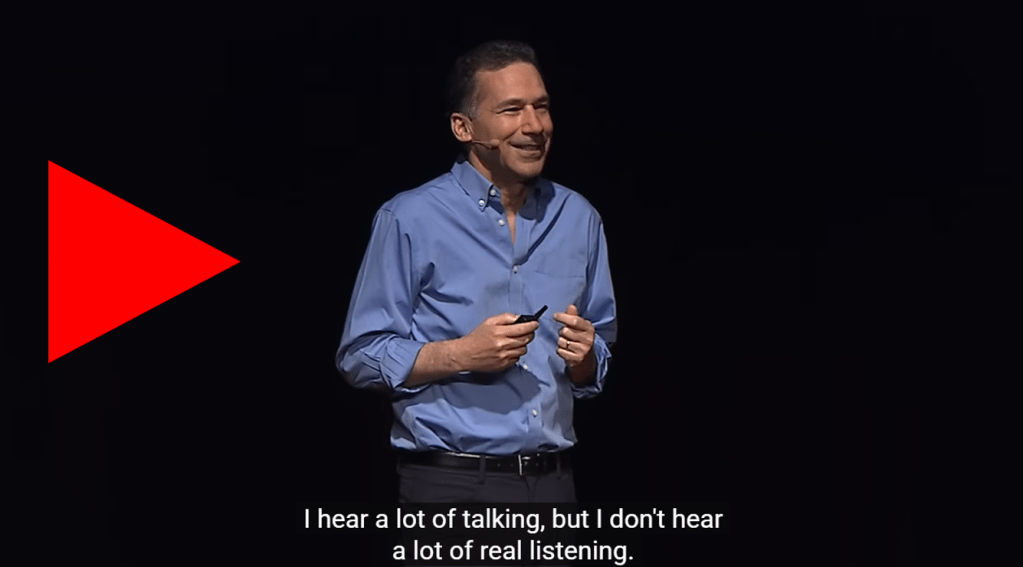
William Ury, an internationally acclaimed teacher of negotiation skills describes the importance of listening skills in this video.
Evaluate and practise your listening skills
More listening and note-taking exercises
- At any meeting, or even during a casual conversation, ask permission to take notes. After taking notes for 10–15 minutes, reconstruct what was said briefly as bullet points. Ask the speaker(s) to review your bullet points and check for mistakes, misunderstandings, or significant omissions.
- Download the listening skills worksheet from the online appendix. Use this to observe different listening behaviors while watching other people in conversation or sitting in a meeting. Make sure you do this discreetly, or ask permission first, as many people can be quite offended if they think you’re trying to watch them too closely.
- The Australian Broadcasting Corporation (ABC) Radio National website provides a valuable resource to practice listening and note-taking. The website provides podcasts of many programs, as well as full transcripts.
- Each day, listen to any recorded program that interests you, for which ABC also provides a transcript. Listen to no more than 7–10 minutes while taking notes. Do not press pause: let the recording play at normal speed.
- Alternatively, choose a podcast that interests you and use software to generate a transcript of the talk.
- After completing your notes, reconstruct what was said as best you can from your notes: a set of bullet points is sufficient.
- Use a word processor to open the transcript from the ABC website, or print out a copy of the section of the transcript corresponding to the part of the podcast that you listened to.
- Highlight all the text in the relevant section of the transcript that was accurately conveyed by your bullet points.
- Do not highlight any important words or ideas that you missed, or where a word you wrote does not correspond to the word in the transcript. For example, if you wrote ‘specification’ (or abbreviated to spec’n), but the word in the transcript is ‘requirements’, do not highlight the transcript, even though the words can have similar meanings.
- Estimate the percentage of the transcript text that you have highlighted to calculate your score.
Many of my students have started with a score of 5%–10%. However, after practicing a few times, they have improved to 50% or better. Others who started at a level of about 50% have improved to about 80%, some even as high as 90%. Individuals interpret the evaluation criteria differently, so comparison with others is not meaningful. However, anyone can monitor their own progress using this technique.
 THE MAKING OF AN EXPERT ENGINEER