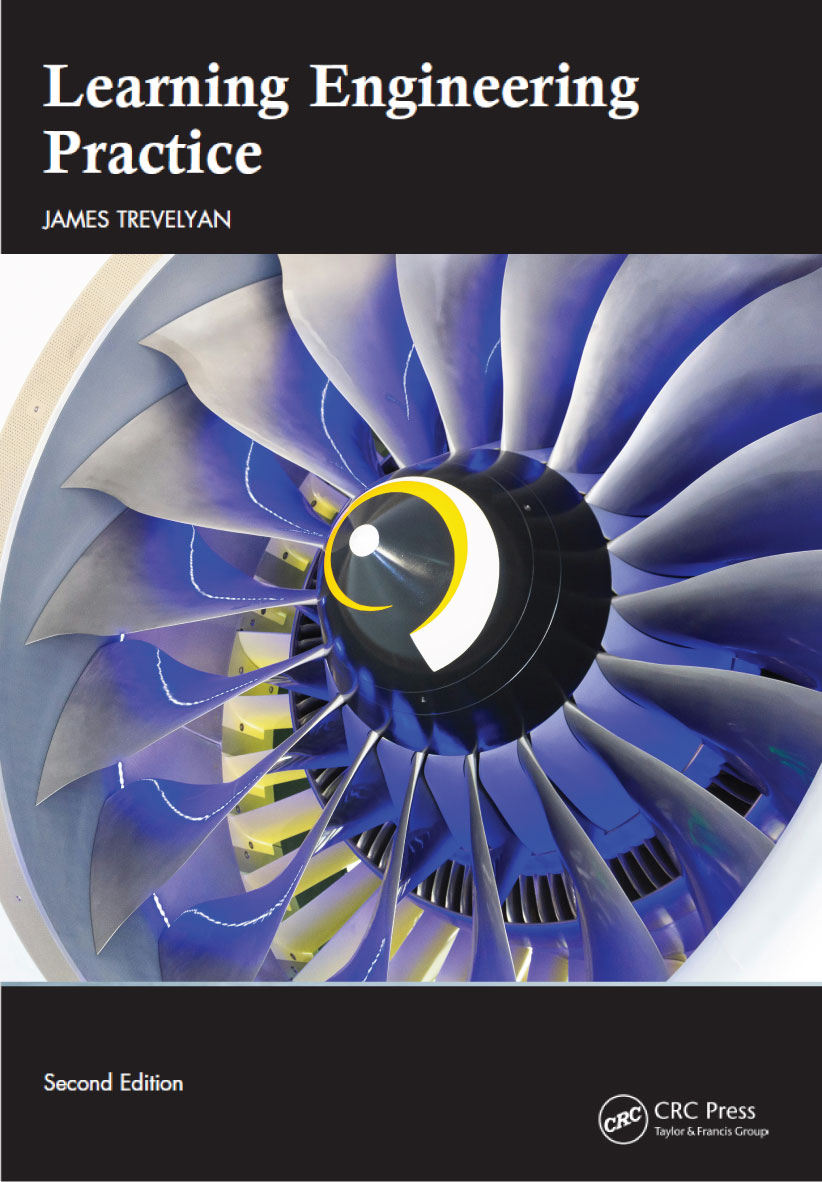
The book is available now at major online bookstores. Check prices: there are remarkable differences between them.

- Routledge Taylor & Francis (publisher)
- Barnes & Noble
- Amazon – search for the ISBN: 9781041170495 if you cannot find the second edition
Download online appendices here.
This is an essential, easy-to-read guide for students, early-career engineers, supervisors, and human resources professionals.
I don’t like to promote myself too much. However, I can reasonably claim, and many others have written to me with similar words, that I am one of the world’s leading authorities on global engineering practices. This is based on 25 years of research, 40 years of teaching engineering, and 50 years of working as a professional engineer in several countries.
This guide will help you learn essential engineering soft skills and specialized capabilities to work as an engineer that universities cannot teach. I explain
- how to gain a job as a new engineer
- how engineers gain access to informal technical knowledge, the experience of other engineers,
- how to gain the willing collaboration of others to make things happen, and
- how to work safely in hazardous environments.
This book also lists effective ways to use the latest digital collaboration tools and artificial intelligence apps, as well as how to estimate costs, generate commercial value, and develop cost-effective sustainable solutions. Lastly, it shows how to understand and navigate the complex working systems and social cultures of engineering firms in a globalized market for engineering services.
Unlike most engineering career books based on personal experience alone, this one is based on systematic research. The insights came from interviews with hundreds of practicing engineers, and field observations in many engineering firms and projects in several countries. The research has been a joint effort with my students and valued colleagues over 30 years.
Anyone who wants to boost their career prospects should also read my earlier book “The Making of an Expert Engineer”. It can help experienced engineers to take their practice to more advanced levels.
To assess how well your own notions on engineering practice line up with research results in a minute or so, try this quiz. You may be surprised with the results, in which case these explanations may help. Check the average score at the bottom of this page to compare your result with others.
Reviews
It’s too early for reviews of the second edition. However, here’s a small selection of unsolicited comments from first edition readers.
“Your book was the only candle in my darkest hour and it set me on a path out of India to Australia. It even helped me land a job here, now in Perth. Have to say you are a hero to me.” Vaishnav 2022
“I read your book “Learning Engineering Practice”. The chapters on generating value, developing perception skills and navigating different social cultures are very useful. These topics were not addressed by my engineering education many years ago.” Greg, 2022
In the last two years i was actually fortunate to work on a large aero-derivative gas turbine development project; and i felt a bit unsettled when we passed certain ‘final design’ milestones in the stage gate process. I felt a kind of ‘what’s the point now, everything is frozen’. Yet i remembered the value creation framework from your book – and so i knew that even though all the design & parts were frozen – the detailed (and sometime tedious) checking work & re-calculations , re-assessment of risks with slightly more mature data – was producing value! It’s actually funny that you had a section on gas turbine design; and were using Rolls Royce cooling air system diagram in the book – because it’s basically my job (at _______, we are ex-RR energy) . I actually read a few of the old RR papers you had listed in your earlier book. And your point about it taking years to train Gas Turbine designers also made me patient in my own work and competence building.” Sam, 2021
“I am a young engineer with 4 years of experience as a sales and support engineer in the robotics and automation industry. My role taught me what university could not about the workforce and how to apply my theoretical knowledge to real world situations. My supervisors provided basic training then trusted me to develop on my own. It was a good learning experience but I eventually began to feel lost and floundering. I needed a mentor but I did not have anyone in my network I could learn from. James’ new book, Learning Engineering Practice taught me the importance of interpersonal skills in the workplace, such as active listening, body language and value generation. As a result, I am now more aware of conflict resolution methods and how to improve the service I provide my clients. Above all else, James’ book reinvigorated my lost passion and interest in engineering.” Darshan, 2021
“I found the book extremely practical and encouraging. The step by step approach really makes the job seeking process feel more structured and manageable. Since coming back, I have been putting your advice into practice. I managed to secure an interview recently, which went well, and I am now waiting on the final confirmation. On top of applying through job sites, I also started walking into companies directly to show my interest. While there were some rejections, a few companies responded very positively, and one of those walk-ins even led to the interview I mentioned. I am really grateful for your guidance, it’s already making a big difference for me and will make a difference in others lives who are trying to get established here.” Majo, 2024
Chapters
The book includes a professional engineering capability framework which provides a curriculum for novice engineers, under guidance from supervisors and mentors. It can be used as a checklist to help guide workplace learning.
Stage 1: Preparation for an engineering career
- Engineering – Doing more with less
This chapter redefines engineering by challenging traditional stereotypes and highlighting the real-world activities that constitute engineering practice. Drawing on decades of research and interviews with engineers across diverse countries, it reveals that engineering is far more than technical problem-solving or design—it is a socially-embedded, collaborative, multidisciplinary process focused on delivering practical solutions that benefit society. Key topics include the importance of collaboration, finance, economic and social impact, sustainability, and the evolving role of artificial intelligence (AI) in engineering. The chapter addresses common misconceptions, emphasizing that so-called “nontechnical” tasks—such as project management, communication, negotiation and stakeholder engagement—are integral to engineering work. It also explores the ethical responsibilities of engineers, the necessity of adapting to global challenges, and the need for sustainable innovation. By providing a comprehensive overview of what engineers actually do, this chapter is essential reading for students, professionals, and anyone searching for accurate information about engineering careers, engineering practice, and the future of the profession in a rapidly changing world.
- Elements of engineering practice
This chapter provides a comprehensive guide for individuals preparing for an engineering career, detailing the core elements and practical skills essential for success in the profession. This is knowledge traditionally described as “experience,” until recently learned entirely by workplace experience alone. The chapter introduces foundation engineering practice concepts, starting by explaining the critical role of finance and the need to demonstrate economic and social benefits. It explains how engineering work is interdependent, requiring collaboration with technologists, technicians and so many other people, in contrast to university studies that value independent thinking and action. It explains how to distinguish between the roles of engineers, technologists, and technicians, and explains the real-world responsibilities that characterize professional engineering work. It defines key concepts, including project management, ethical decision-making, communication skills, technical coordination, risk management, and stakeholder engagement. The chapter emphasizes the value of developing both technical and “nontechnical” skills such as leadership, time management, and business acumen. It also addresses the evolving demands of sustainability, legal compliance, and continuous learning in engineering practice. By outlining the Engineering Practice Checklist and providing real-world examples, this chapter equips aspiring engineers, their mentors, and their supervisors, with actionable insights and a workplace learning curriculum guide. Building on the checklist, it explains how the later chapters in the book each explain the most important concepts that guide practicing engineers in their work.
- Seeking paid engineering work
This chapter provides an extensively tested method to help engineering graduates find paid engineering work which is not known to have failed yet. It is based in the reality that most engineering jobs are never advertised, and explains how to navigate this hidden job market. It takes an entirely different approach from traditionally advocated methods that rely on responding to job advertisements, methods that can be frustrating and time-wasting for many aspiring engineers. The chapter explains how to find engineering jobs by building a professional network, and simultaneously acquiring practical knowledge valued by employers such as researching networks of specialist engineering component, material and service suppliers. It also advocates studying relevant engineering standards usually overlooked by university courses, macro and Python programming, and also researching the costs and availability of commonly required engineering supplies. Readers can acquire detailed practical knowledge on how to set up their home studio with appropriate equipment so that they will stand out from other job applicants in virtual interviews by ensuring top class video and audio quality and practiced responses to typical interview questions. The chapter also explains how to navigate applicant tracking systems and evaluate which job opportunities offer values alignment, known to be the best predictor of long term employment satisfaction.
- Essential professional skills
This short chapter starts by emphasizing common professional skill weaknesses among engineering newcomers, particularly their overreliance on text communication. The chapter goes on to explain how engineers, above all else, must be proficient influencers if their work is to have any impact. There is a section that explains why developing collaboration skills that work outside the scope of traditional teamwork methods is so important in engineering. Unlike conventional expositions of communication skills for engineers, the chapter explains the critical important of perception skills: listening, reading and visual perception. It explains how listening is critical to pick up the language and terminology used by people such as accountants whom engineers need to influence. By using their terminology appropriately, it is far more likely that influencing can be effective. Then the chapter explains how prior knowledge is essential for perception, yet at the same time can prevent accurate assessment of the world as it actually is.
- Foundation skill 1 – Listening
Another short chapter introduces effective listening skills for engineers. It starts by pointing out the critical importance of accurate listening since engineers spend 20% – 25% of their time listening. Many engineering newcomers confuse hearing with listening. The chapter provides an introduction to practice exercises known to improve listening skills and note-taking proficiency. The chapter lists AI apps that can help transcribe conversations. However, the author’s extensive experience reveals that the most valuable conversations often take place without warning, in noisy locations with heavily-accented speech which is difficult for apps to transcribe. Further, many people who might reveal valuable information are reluctant to speak if they know they are being recorded. The chapter concludes by explaining how the listener can only reconstruct the ideas of the speaker in terms of their own ideas, an imperfect, interactive interpretation performance where interpretation gaps are inevitable. The chapter provides references for readers to further develop their listening skills. The chapter provides a helpful introductory video to complement the written material and links to resources for practicing and improving listening skills.
- Foundation skill 2 – Reading documents
Like listening, reading extensive, detailed documents to acquire knowledge is critically important for engineers. The chapter explains methods based on practice by leading engineering companies on how to accurately ascertain important requirements from documents, as well as basic speed-reading methods. The chapter also provides a helpful introductory video to complement the written material. The best methods rely on engaging colleagues to help identify critical requirements and their relative priority. The chapter provides a worked example to demonstrate how this can be done.
- Foundation skill 3 – Reading people: emotional intelligence
Reading peoples’ emotions is equally important as reading documents, but for many engineers this can be considerably more challenging. The chapter introduces a family of methods around the notion of emotional intelligence, and provides a helpful video explaining the relevance for engineers. The chapter explains the relevance of body language and the importance of self-awareness. It explains in more detail why relying on email and text messages is more likely to inflame a conflict or disagreement. The chapter explains practices such as bullying and coercive control and their harmful consequences in any workplace. Resolving conflict can start with careful, attentive listening to all parties. However, in this short chapter, the advice is to refer any unresolved conflict to human resources specialists or management.
- Foundation skill 4 – Seeing and creativity
This chapter introduces the third and last of the key perception skills for engineers. There are introductory exercises for the reader to evaluate visual perception skills. The chapter refers readers to a graded set of exercises in the online supplement to further improve their skills. This short chapter links visual perception with creativity, especially for design, which relies on accumulated tacit knowledge of existing designs experienced in the past. Freehand sketching and notes provide an excellent method for accumulating this store of tacit knowledge. Most of the expert designers interviewed by the author had followed this practice. Like the other chapters on perception, there is a link to an introductory video to complement the text. The chapter returns to the theme explored in the earlier chapters, demonstrating how prior knowledge can interfere with visual skills, making it more difficult to perceive reality as it actually is.
Part 2: Starting an engineering career
A good way to start the second half of the book is to watch some videos that show the actual work of engineers.
- Learning the ropes
This chapter explains how an engineering newcomer can prepare for and get the most out of the first few weeks in their first engineering job. The chapter emphasizes the first section of the Engineering Practice Checklist, included in the book’s appendix, describing generic and technical activities for which a newcomer will be responsible in their first few weeks and months of practice. The chapter explains how to ascertain a supervisor’s expectations, and discuss written requirements to clarify any misunderstandings. It is important to agree on the completion criteria: how both the reader and supervisor will know that the work has been completed to an agreed standard. Equally important is learning to plan work and secure access to the necessary resources. Another important set of activities for the first few weeks is obtaining access to the employer’s information systems and learning how to use them. Equally important is accounting for the work hours needed to complete different tasks and building a professional network of people in the enterprise or firm. Asking the supervisor or mentor to describe instances of dishonest behavior can help a newcomer identify conflicts of interest and situations that require consideration of ethical obligations. The closing section of the chapter explains why maintaining high ethical standards has practical value in engineering practice.
- Specialized engineering knowledge
This chapter explains the significance and different types of knowledge that engineers and others use in engineering enterprises. Knowledge is defined as justified true belief in the mind of a person, influencing their thinking and actions. Information, on the other hand, can represent knowledge but exists in media such as computer memory, books and journals. This representation is classified as explicit knowledge, knowledge in written form, and can be accurately transferred quickly from one place to another. The chapter describes other forms of knowledge such as implicit knowledge, tacit knowledge, procedural knowledge and contextual knowledge with representative engineering examples. Transforming information into knowledge in the mind of an person is a slow and error-prone process requiring substantial effort. Knowledge carried by people is often termed “sticky knowledge” because it is difficult to transfer to other people. This critical observation influences many of the engineering practices described in subsequent chapters.
- Engineering knowledge is a social network
This chapter starts with the notion of sticky knowledge from the last chapter. The text points out that information in documents cannot influence thinking and action until it has been studied and transformed into knowledge in the minds of readers. Because of these human limitations, much of the knowledge needed by engineers is carried in the minds of people, and contributed when needed with willing, skilled, knowledgeable, and conscientious performances. Mapping different categories of technical and generic knowledge helps demonstrate the extent and complexity of engineering knowledge and information resources. Several engineering examples show how this can be done. An engineering newcomer soon learns that most of the knowledge they need is known by someone in the organization. Organizational knowledge, therefore, can be visualized as a social network. Accessing that knowledge depends on traversing a social network of people with different expertise, building collaborative and trusting relationships along the way. The challenge is to gain the willing collaboration of these people to spend enough time to contribute their expertise. As different people collaborate, each contributing different expertise, distributed cognition comes into play: new knowledge and understandings emerge from conversations between these people in both workplace and social settings.
- Making things happen: technical coordination
This chapter describes technical coordination one of the most important elements of engineering practice. It is an informal and largely undocumented process that involves gaining the willing and conscientious collaboration of people to contribute skilled performances using their special expertise according to an agreed time schedule. It typically occupies about 30% of an engineer’s time. Willing collaboration comes from mutual respect: using organizational authority can be counterproductive. While it is possible to gain collaboration through the organization hierarchy, often the requirements are misunderstood, and the wrong person may be engaged to perform the work. Technical coordination relies on collaborative, trusting relationships developed over time. It is still possible without these, but extra time and effort is needed for agreeing on the requirements, supervision, and monitoring as the work progresses to ensure that, as far as possible, the original intentions are respected. Follow-up monitoring is essential and the chapter describes ways to achieve this without irritating the person being engaged to perform the work. While technical coordination resembles project management in principle, the informality and lack of any extensive documentation demand different collaboration methods.
- Learning to work safely
This chapter explains the responsibilities of professional engineers to ensure safety in the workplace, a legal requirement in most developed countries. The text reminds the reader that the best way to eliminate most safety hazards is to design them out of the solution. Readers learn about risk management and identifying risks, unpredictable but foreseeable events with potentially hazardous consequences, and how to assess the consequences. Selecting appropriate control measures to reduce the likelihood of risk events and reducing the consequences comes next, with the order based on the most important events with extreme consequences first. Recent experiences with major accidents shows that these events must be addressed with control measures, no matter how unlikely they seem to be. The bowtie diagram is introduced as a handy way to visualize of the causes, consequences and appropriate controls for each risk event. Readers can learn about importance of culture as an influence on human behavior, particularly the safety culture within the enterprise, and how to observe its influence. The chapter also shows how cultural influences from the wider society hosting the enterprise can influence behavior and how to work with these ideas to improve safety.
14. Engineering projects – making big things happen
Project management is an essential element of engineering practice. This is a formally documented process that starts with the development of a project plan, identifying all the activities needed to complete the project. While there are many excellent texts, nearly all miss three critical elements needed for engineering projects.
The first element is the difference between information, represented by the formal documents created through the project management processes, and knowledge in the minds of the people executing the project. The existence of information represented by the formal project documentation is not sufficient to ensure that people have studied the documents and developed knowledge in their minds so they act on that information.
The second critical element is technical specifications, defining the technical requirements of the artifacts created during the project. Without agreed specifications, one cannot identify the activities needed to ensure that artifacts meet the specified technical requirements, and hence complete the project plan.
The third frequently overlooked element is the collection of inspection and test plans needed to confirm that artifacts comply with specified requirements and are fit for their intended purposes, and hence determine that activities in the plan have actually been completed.
The chapter explains each of these elements in sufficient detail for the reader to build on widely available project management texts. Gantt charts, critical path and resource analysis are briefly introduced in the context of engineering projects. The early part of the chapter also explains the importance of front end loading in helping to reduce the chance of project failures such as a case study presented in chapter 20.
- Generating value in the enterprise
Research has shown that a common attribute of the highest paid engineers is an ability to describe how their work creates, delivers and protects commercial value in a broad sense meaningful for investors. Most engineers struggle to understand this idea beyond simplistic efficiency gains and NPV analysis. This chapter, for engineering newcomers, explains how investors understand concepts of value generation and how this explains major financial decisions. Value can be a confusing term for engineers, for whom it most often means a number in a spreadsheet cell with quantifiable precision. The chapter describes how value for an investor is entirely different, and often only a qualitative feeling of confidence that results in a subjective “gut feel” decision on whether to commit finance for an engineering project. Conventional economics theory only explains engineering value generation in terms of innovation and R&D. This chapter extends conventional theory to describes how ordinary, everyday, routine engineering activities contribute to value generation. While this might seem to be a topic more suited to managers, engineering newcomers have much to gain from learning the ideas in this chapter. Understanding how commercial value is generated from engineering activities will improve newcomers’ employability and job security, as well as leading eventually to higher financial rewards. A case study demonstrates the application of these ideas in a small family-owned manufacturing business.
16. Estimating Cost
Accurate cost estimation is an effective way to accelerate any engineering career. Seldom if ever taught in universities, cost estimation is usually based on proprietary tables of rates and uplift factors to account for more difficult or unpredictable activity locations at heights, underground, unstable countries, remote places or offshore. Understanding how to account for labor costs is fundamental and widely misunderstood by engineers who tend to focus only on direct salary costs. Few engineers are aware of many significant indirect costs. This short chapter finishes with an essential discussion to complement the chapter on value generation: what it costs to employ engineers. Engineers need to ensure their work contributes greater value than what it costs to employ them, and this can be more challenging that it seems. Newcomers will be surprised by some of the content in this chapter.
17. Organizations, systems, culture and agency
This chapter introduces essential concepts from the social sciences to understand the main factor influencing the performance of individual engineers. This factor is the organization that employs them and the supporting infrastructures that so many engineers take for granted. Larger firms tend to have more extensive and rigorous systems and procedures in place, limiting the agency of engineers: their ability to act on their own initiative. Many engineers yearn for the relative freedom of smaller firms with fewer operating constraints, and they see the cumbersome procedures that constrain their work in larger firms as impediments. Yet it is these systems and procedures that give larger firms distinct advantages with clients, enabling their engineers to earn higher salaries. Culture is another strong influence on performance and the chapter explains why this is the case, especially the effect of social culture in many developing countries. The chapter describes many of the management systems that larger firms use to provide greater value for clients such as project management, quality management, change and configuration management and maintenance management. Like the previous chapter on estimating costs, this chapter will surprise many engineering newcomers, and many experienced engineers as well.
18. Design for sustainability and resilience
Conventional treatments of sustainability in engineering focus on technical issues to help product designers reduce pollution and CO2 emissions, use renewable energy, improve energy efficiency and employ environmentally friendly materials. Sustainability will follow, they argue, if every engineer adopts these approaches. However, most engineers face clients who demand least cost solutions with minimal if any compliance with environmental and safety regulations, especially in countries with the largest environmental footprints. How can engineers persuade clients to adopt resilient and sustainable solutions that cost more? This chapter provides answers based on case studies. Sustainability aligns with least cost when solutions use five times less energy and significantly less material while meeting clients’ needs. Amory Lovins advocated these solutions because they are more likely to achieve large productivity gains to advance the UN Sustainable Development Goals. An increased need for resilience in the face of extreme weather and frequent economic disruptions also opens opportunities for a risk-based argument that can be equally effective commercially. The author also advocates greater understanding of Australian aboriginal culture that has survived for more than 50,000 years on a continent with a harsh and unforgiving climate. No other human society has achieved similar sustainability.
19. Time management
Leslie Perlow described the “time famine” that characterizes the work life of engineers, suggesting that effective time management is essential for survival. This short chapter provides tools for engineering newcomers to evaluate and improve their time management. By increasing self-awareness and building on physiology and psychology research, engineers can plan their schedules to make the best use of their time while meeting the needs of coworkers. Learning to say “no” by saying “yes” can help clear space in a crowded diary. Allowing time for unforeseen interruptions is also essential.
Chapter 20: Learning from failure
Failures occur when performance fails to meet reasonable expectations. Engineering failure reports provide some of the richest information sources that can help engineers avoid failures. The Hyatt Regency collapse in 1981 reveals how successive reinterpretations of engineering designs result in misunderstandings that can cause catastrophe without appropriate checking. Most research on human error and safety overlooks the possibility of deliberate deception exemplified by the Volkswagen diesel emission cheat devices. The Flixborough chemical plant explosion and the Callide electricity generator explosion both illustrate how lack of engineering attention on maintenance and repairs can easily make safe designs extremely dangerous. The Hong Kong XRL project illustrates how insufficient front end planning and detailed design can lead to schedule and cost blowouts, sadly a frequent occurrence in engineering projects. Finally the Opal Towers and similar construction industry failures forced Australian governments to adopt tighter regulation of engineers, following similar measures in several other countries. The chapter provides links to complementary videos and references original reports that make rewarding and instructive reading. Some provide practical suggestions on how to implement contemporary process safety practices in organizations.
Appendix
Professional Engineering Checklist
Online Appendices:
Listing Skills Worksheet
Learning to See by Sketching
Life Cycle Costing Guide
Engineering Practice Bibliography
Quiz Scores
Average engineering practice quiz score: 60% – range is 20% – 90%. Remember, the quiz is based on research which you may not have had a chance to read yet. My earlier book “The Making of an Expert Engineer” will tell you more.